
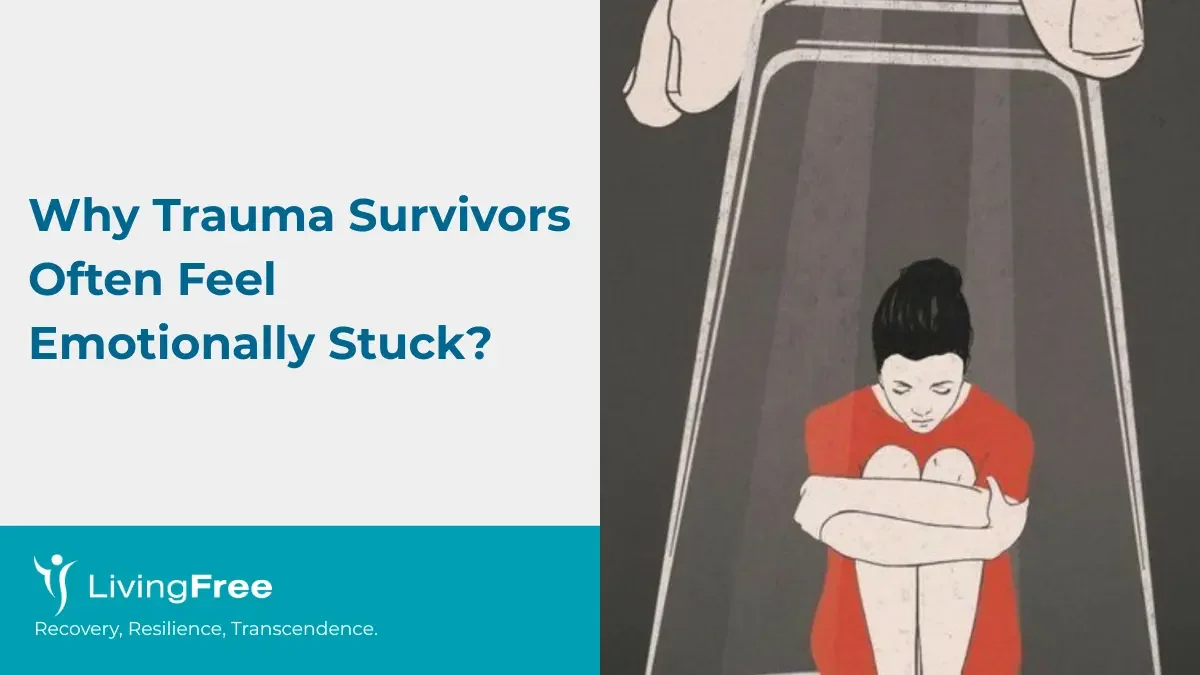
If you have ever felt like your life is moving forward while some part of you stayed behind, you are not imagining it. Many trauma survivors describe a strange sense of being frozen in time, as though the calendar keeps turning but their inner world never quite caught up. This feeling of being emotionally stuck is one of the most common and most misunderstood experiences among people who have lived through overwhelming events. It is not laziness, weakness, or a lack of willpower. It is the predictable result of how the brain, body, and nervous system respond to experiences that were too much to fully process at the time they happened.
Understanding why this happens is often the first real step toward moving through it. Below, we walk through the science behind emotional stuckness, the ways it shows up in daily life, and what actually helps people begin to unfreeze.
Table of Contents
The Body Remembers What the Mind Tries to Forget
Psychiatrist Pierre Janet first observed more than a century ago that intense emotional experiences can interfere with the way memories are integrated into a person’s ongoing life story. Instead of being filed away as something that happened in the past, traumatic material can remain dissociated from conscious awareness and stored instead as raw physical sensations, images, and impulses (van der Kolk, 1994). This early observation has been echoed and expanded by decades of trauma research since.
Psychiatrist Bessel van der Kolk built on this idea in his influential work, showing that traumatic experiences are not simply psychological events. They are embodied phenomena, held in the nervous and muscular systems long after the danger has passed (van der Kolk, 2014). This is part of why people can intellectually understand that they are safe now, yet still feel a jolt of fear, shame, or panic in situations that resemble the original trauma. The thinking brain has moved on. The body has not.
This disconnect explains a lot of what survivors describe:
- Feeling triggered by something small with no clear reason why
- Reacting to present-day stress with an intensity that seems disproportionate
- Struggling to explain, in words, what actually happened or how it felt
- Sensing that a part of them is still living in the moment the trauma occurred
Many survivors wonder whether simply talking through the traumatic event enough times will resolve this. Sometimes it helps, but not always, and for some people repeated retelling without proper pacing or support can actually reinforce distress rather than resolve it. We go into this in more depth in our article on whether talking about trauma can make it worse, which is worth reading if verbal processing has felt unhelpful or even harmful for you in the past.
The Nervous System Gets Stuck in Survival Mode
One of the most useful frameworks for understanding emotional stuckness comes from Stephen Porges’ polyvagal theory. Porges described how the autonomic nervous system organizes its response to threat through a hierarchy of three states: a calm, socially engaged state governed by the ventral branch of the vagus nerve, a mobilized fight or flight state driven by the sympathetic nervous system, and an older, more primitive shutdown state governed by the dorsal branch of the vagus nerve (Porges, 2001; Porges, 2011).
When fighting or fleeing is not possible, whether because a person was a child, outnumbered, or otherwise trapped, the nervous system defaults to this dorsal vagal shutdown. It is the same mechanism that causes an animal to go still when caught by a predator. In humans, this can look like:
- Emotional numbness or a sense of watching your own life from a distance
- Chronic fatigue that rest does not seem to fix
- Difficulty starting tasks, even ones you genuinely want to do
- A feeling of being disconnected from your own body
The trouble is that this survival state was designed to be temporary. When the threat is not fully processed, the nervous system can remain locked in this pattern long after the danger has ended, cycling between shutdown and hyperarousal rather than settling into a genuine sense of safety. This is not a character flaw. It is a nervous system doing exactly what it was built to do, just at the wrong time.
A Narrowed Window of Tolerance
Psychiatrist Daniel Siegel introduced the concept of the window of tolerance to describe the zone of arousal within which a person can experience emotions as manageable, think clearly, and stay present with others (Siegel, 1999). Inside this window, stress is uncomfortable but workable. Outside of it, a person tips into either hyperarousal, marked by anxiety, panic, or reactivity, or hypoarousal, marked by numbness, collapse, and disconnection.
Research building on Siegel’s model has found that severe or chronic emotional trauma tends to narrow this window considerably, leaving survivors more easily pushed into extreme states by reminders of the original experience, and with fewer internal resources available to bring themselves back to center (Corrigan, Fisher, & Nutt, 2011). This narrowing helps explain why something that seems minor to an outside observer, a certain tone of voice, a smell, a delay in a text reply, can send a trauma survivor into a full-body stress response within seconds.
Over time, many survivors develop coping strategies specifically to avoid leaving their narrow window of tolerance. These strategies are not failures. They are adaptations. But they can also be part of what keeps a person feeling stuck, since avoiding triggers also means avoiding the very experiences that could help expand the window and build genuine resilience.
Why Insight and Mindfulness Alone Are Often Not Enough
It is a common and frustrating experience for survivors to spend years in therapy building a clear intellectual understanding of their trauma, only to find they still react the same way in their bodies. This happens because trauma is stored in networks outside of the language centers of the brain. During an overwhelming event, brain imaging research has shown reduced activity in Broca’s area, the region responsible for speech production, alongside increased activity in areas associated with visual and emotional processing (van der Kolk, 2014). This is part of why some trauma is described as speechless, and why insight on its own does not always change how the body responds.
This is also why mindfulness, while genuinely valuable for many people, does not work the same way for everyone recovering from trauma. Sitting quietly with sensation can be grounding for some survivors and destabilizing for others, particularly if their nervous system has not yet developed enough capacity to tolerate stillness without spiraling into anxiety or dissociation. If you have tried mindfulness and found it unhelpful or even distressing, you are not doing it wrong. We explore this in detail in why mindfulness alone often fails trauma survivors, including what tends to work better for a dysregulated nervous system.
Dr. Reshie also cautions that insight alone is rarely enough if the nervous system remains disconnected from the body. As he explains,
“The body keeps the score… It doesn’t help people to take the scorecard. It just allows… the opposite. It basically prolongs the situation.”
His point highlights why many trauma survivors need approaches that involve the body as well as the mind, rather than relying solely on intellectual understanding.
How Emotional Stuckness Shows Up in Relationships
Trauma does not stay contained to the person who experienced it. It shapes how survivors communicate, connect, and set boundaries with the people around them. Someone stuck in a sympathetic, high alert state may come across as reactive, controlling, or quick to anger, while someone stuck in a dorsal vagal shutdown may seem withdrawn, indecisive, or emotionally unavailable, even when they deeply care about the relationship in front of them.
Common relational patterns tied to unresolved trauma include:
- Difficulty identifying or naming what you need from another person
- Fear of conflict that leads to over-apologizing or people pleasing
- Struggling to trust that someone’s calm behavior is genuine rather than a prelude to danger
- Shutting down emotionally during disagreements instead of engaging
These patterns are frequently misread by partners, friends, and family members as disinterest or dishonesty, when they are actually survival strategies playing out in real time. Our piece on how trauma affects communication styles looks more closely at these dynamics and offers a more compassionate framework for understanding them, both for survivors and for the people who love them.
Common Signs of Feeling Emotionally Stuck
Emotional stuckness after trauma can look different from person to person, but certain patterns tend to recur. You might recognize some of the following:
- A persistent sense that life is not moving forward, even when circumstances have objectively changed
- Repeating the same relationship or behavior patterns despite wanting something different
- Physical symptoms such as chronic tension, headaches, or digestive issues with no clear medical cause
- Difficulty feeling joy or excitement, even about things you used to love
- A sense of shame around still being affected by something that happened long ago
- Sleep that does not feel restorative, or a nervous system that seems to stay “on watch” even at night
Deep-seated shame deserves particular attention here, since it is one of the most common emotions trauma survivors report and one of the most powerful forces keeping people stuck. Shame tends to whisper that something is fundamentally wrong with you, rather than something difficult having happened to you. That distinction matters enormously for healing.
Myths That Keep People Stuck Longer
Part of what prolongs emotional stuckness is misinformation about how healing actually works. Many survivors believe they should simply be over it by now, that healing means never being triggered again, or that if therapy has not fixed everything within a certain timeframe, something is wrong with them. None of these beliefs hold up against what research actually shows about trauma recovery.
We unpack several of these misconceptions in common trauma healing myths, which can be a helpful read if you have been measuring your progress against an unrealistic standard.
What Actually Helps People Move Through Stuckness
Because trauma is stored in the body and nervous system rather than only in memory, the most effective approaches tend to engage both mind and body together, rather than relying on talking alone. Some approaches supported by clinical literature include:
- Somatic and sensorimotor approaches: Therapies that work directly with bodily sensation and movement can help complete the physiological stress response that trauma left unfinished (Ogden, Minton, & Pain, 2006; Levine, 2010)
- Titrated processing: Approaching traumatic material in small, manageable doses while staying within the window of tolerance allows the nervous system to process without becoming overwhelmed again
- Co-regulation: Healing frequently requires feeling genuinely safe with another person, whether a therapist, support group, or trusted loved one, since much of what was ruptured in relationship is repaired in relationship
- Gentle, consistent nervous system care: Predictable daily rhythms help signal safety to a nervous system that has learned to expect chaos. Our guide to morning routines that support a healing nervous system offers a practical starting point
Recognizing when you are ready to pursue deeper trauma work is its own important step, and it does not have to happen all at once. If you are weighing whether now is the right time, how to know if you’re ready for trauma therapy can help you think through that decision without pressure.
Complex PTSD researcher Pete Walker described freeze, along with fight, flight, and fawn, as one of the primary trauma responses, characterized by emotional shutdown and a felt inability to respond once triggered (Walker, 2013). Recognizing which of these patterns tends to show up for you is not about labeling yourself. It is about understanding your own nervous system well enough to work with it instead of against it.
Final Thoughts
Feeling emotionally stuck after trauma is not a sign of weakness or failure. It is what happens when a nervous system that once had to survive something overwhelming has not yet had the chance to fully complete that process and return to a genuine sense of safety. The good news, supported by decades of research into the brain, body, and autonomic nervous system, is that this state is not permanent. With the right support, the window of tolerance can widen, the body can release what it has been holding, and forward motion becomes possible again. At livingfree.today, we believe healing is not about erasing what happened, but about helping the whole person, body and mind together, come back online.
If any part of what you read here feels familiar, you do not have to sort through it alone. Our team understands the science behind emotional stuckness and how to translate it into real, sustainable steps forward. Contact us to talk about what support could look like for you.