
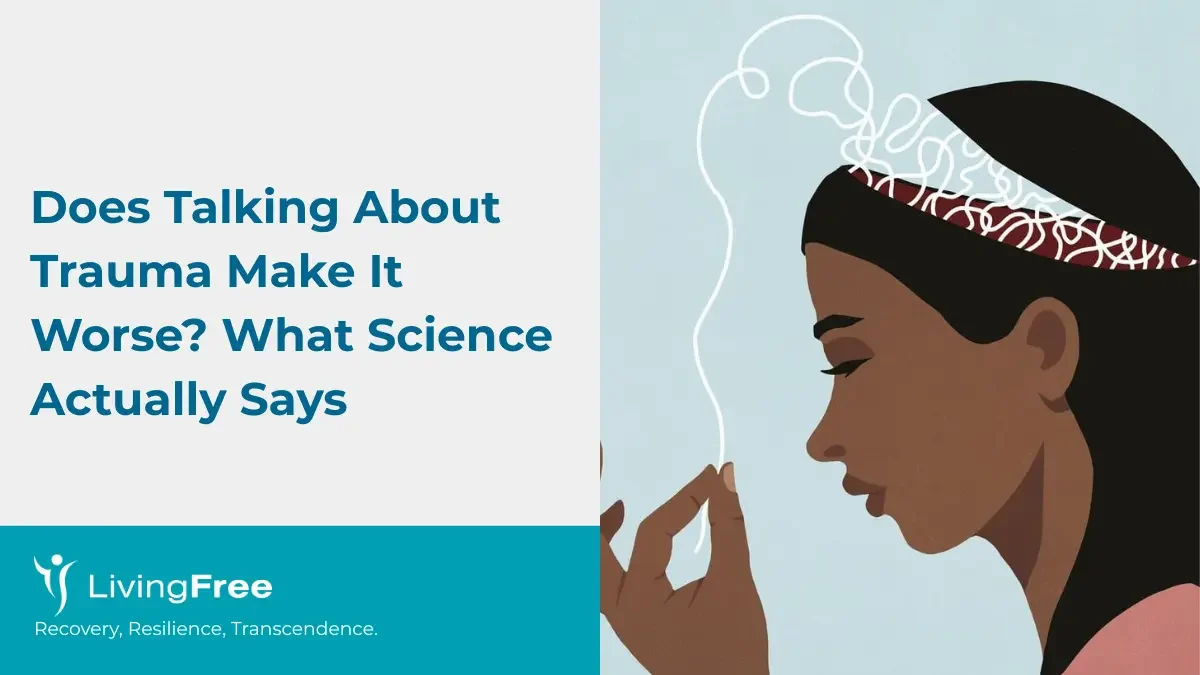
There is a question many trauma survivors quietly carry: Will saying it out loud make it worse? It is a reasonable question, and one that keeps countless people from ever seeking help. The answer, as researchers and clinicians have come to understand, is not a simple yes or no. Whether talking about trauma helps or hurts depends enormously on how it is done, with whom, and when in the healing process it occurs.
Why the Brain Reacts to Memory the Same Way It Reacts to Danger
To understand why talking about trauma can sometimes intensify symptoms, it helps to look at what happens in the brain when a traumatic memory is recalled. When a person visualizes or narrates a distressing past event, the brain does not cleanly distinguish between a memory and a present-moment threat. Instead, it triggers the same cascade of stress hormones, including adrenaline and cortisol, that it would if the danger were happening right now. This activates the fight, flight, or freeze response: breathing quickens, the heart races, muscles tense, digestion slows, and vision narrows.
This is not a flaw in the system. It is a survival mechanism. But it means that retelling a traumatic story without adequate nervous system support can, quite literally, put the body back into crisis. Trauma is not stored in the brain like a coherent narrative with a beginning, middle, and end. According to Bessel van der Kolk, one of the world’s most cited researchers on traumatic stress, trauma is encoded as physical sensations, images, and emotional responses, often entirely without language. His decades of work, summarized in The Body Keeps the Score (2014), demonstrate that trauma lives in the survival parts of the brain, not the rational, language-based areas, which is why talking alone so often falls short.
If you have ever wondered why trauma affects your everyday decision-making long after the original event, this neurological reality is a central part of the answer. The survival brain does not update its threat assessment through conversation. It updates through felt safety.
Table of Contents
When Talking Makes Trauma Worse: The Research
A study published in the Journal of Consulting and Clinical Psychology, funded by the National Science Foundation and the National Institute of Mental Health, followed approximately 2,000 Americans in the aftermath of the September 11, 2001 attacks. Researchers compared those who chose to openly express their emotional responses to those who stayed quiet. What they found challenged conventional assumptions: those who articulated their feelings at length tended to report more symptoms of post-traumatic stress, more general stress, and more physician-diagnosed physical ailments over the following two years. The more in-depth their initial response, the worse their outcomes.
This does not mean silence is the answer. The researchers themselves noted that those who spoke may have simply been more deeply affected to begin with. But the findings point to something important: immediate, unstructured emotional discharge after trauma does not automatically produce healing. Sometimes, it reinforces the very neural pathways keeping a person stuck.
This is consistent with what trauma-informed clinicians observe in practice. Repeatedly narrating a traumatic event, without body-based regulation or a felt sense of safety, can strengthen the fear, panic, and shame pathways in the brain, making them faster to activate and harder to quiet. Trauma researcher and writer Carolyn Spring, who has documented her own experience with complex trauma, describes this vividly: when trauma survivors return to the narrative of what happened, they are often flooded again with flashbacks, pain, distress, and shame. Without proper therapeutic support, going back there can open a wound without completing its healing.
Some people who have undergone Prolonged Exposure Therapy, a treatment that involves systematically revisiting traumatic memories, report that re-exposure made things worse rather than better. For these individuals, approaches that redirect thoughts rather than re-immerse them, such as Cognitive Processing Therapy, have proven more effective. The key distinction is whether the nervous system is being regulated during the process or simply overwhelmed by it.
This is also why symptoms often fluctuate during trauma healing, sometimes intensifying before they ease. That fluctuation is not always a sign of failure. It may reflect the nervous system’s attempt to integrate material it was not previously ready to process.
The Nervous System Problem: Why Insight Alone Is Not Enough
One of the most important distinctions in modern trauma science is the difference between top-down and bottom-up healing. Top-down healing works through cognition: understanding what happened, reframing beliefs, gaining insight. Talk therapy is primarily a top-down approach. Bottom-up healing works through the body: regulating the nervous system, releasing stored physical tension, restoring a felt sense of safety.
Trauma lives in the bottom-up system. Van der Kolk’s research, along with work by somatic practitioners like Peter Levine (developer of Somatic Experiencing) and psychiatrist Stephen Porges (creator of Polyvagal Theory), has established that traumatic experiences recruit the defense circuits of the autonomic nervous system and leave them dysregulated. The symptoms that follow, including hypervigilance, dissociation, emotional numbness, and physical tension, are expressions of a nervous system that never received the signal that the danger is over.
This is why high-functioning adults can explain their trauma with precision and still feel their bodies react as if danger is imminent. Understanding does not retrain the nervous system. Safety does. And for many people, the experience of trying to talk through trauma without that foundational sense of safety leaves them feeling worse after therapy than before it, which is disorienting and discouraging, but not a sign that healing is impossible.
It is worth noting here that for some people, particularly those who have developed impostor syndrome as a result of their trauma history, the very act of entering therapy can feel paradoxically threatening. The therapeutic relationship itself may trigger old relational wounds, which is why building safety within that relationship is not a preliminary step before the real work begins. It is the work.
When Talking About Trauma Does Help
None of this means that talking about trauma is inherently harmful or that silence is healing. The evidence for the therapeutic value of trauma disclosure is also substantial. Avoiding a traumatic experience entirely does not make it disappear. Unspoken trauma tends to accumulate in the body and mind, contributing to depression, anxiety, PTSD, and physical health problems. Keeping trauma secret preserves its power; speaking it in a safe context begins to dismantle that power.
The critical variable is not whether you talk, but how the talking happens. When trauma is discussed within a therapeutic relationship that provides warmth, attunement, and genuine felt safety, when body-based grounding accompanies the narrative, when the conversation is paced carefully rather than rushed toward disclosure, talking can be deeply healing. The narrative itself can become a vehicle for integration rather than re-traumatization.
Effective trauma-informed therapy works on the principle of titration: offering small, manageable doses of exposure to difficult material, rather than requiring a person to wade into the deepest water before they have learned to swim. This approach respects the nervous system’s pace and builds regulatory capacity alongside, or even before, narrative exploration.
If you are wondering how long trauma therapy actually takes, the honest answer is that it varies considerably. But what research and clinical experience consistently show is that approaches that integrate the body alongside verbal processing tend to produce more lasting results than talk alone.
The Role of Safety in Trauma Disclosure
There is a reason why trauma therapists spend considerable time building the therapeutic relationship before approaching the most difficult material. Safety is not a nice-to-have preliminary step. It is the prerequisite for any meaningful healing to occur.
Trauma, particularly relational trauma, disrupts a person’s fundamental sense of who can be trusted and when it is safe to be vulnerable. For many survivors, the therapist represents a complex and contradictory figure: simultaneously the person most capable of helping and the most capable of triggering old wounds. This is what attachment researchers call disorganized attachment, and it means that pushing a client toward trauma disclosure before they have genuinely experienced the therapeutic space as safe is likely to produce avoidance, dissociation, or overwhelm rather than healing.
People also need practical internal resources before approaching the most painful material. Life circumstances matter: moving, grief, job loss, or other acute stressors may mean that a person simply does not have the bandwidth to revisit early trauma, and that is not resistance or avoidance in a pathological sense. It is the reasonable wisdom of a system that knows it cannot handle more than it can hold right now.
This reality also intersects in interesting ways with collective versus individual trauma. When entire communities share a traumatic history, the dynamics of disclosure, safety, and healing become even more layered, shaped by cultural norms, generational patterns, and the presence or absence of communal acknowledgment.
What Actually Heals Trauma
If talking alone does not heal trauma, what does? Research over the past three decades has pointed consistently toward approaches that engage the body and nervous system alongside, or instead of, pure narrative disclosure.
Eye Movement Desensitization and Reprocessing (EMDR) has accumulated a strong evidence base for trauma treatment. It allows the brain to reprocess traumatic memories without requiring detailed verbal retelling. The focus is on how the memory is stored in the nervous system, not simply on narrating what happened. Somatic Experiencing, developed by Peter Levine, works with physical sensations to allow the body to complete survival responses that were interrupted during the traumatic event. Internal Family Systems therapy (IFS) helps people engage compassionately with protective parts of themselves, including numbness, hypervigilance, and avoidance, without forcing exposure or overwhelm. Yoga, neurofeedback, and trauma-sensitive movement practices have also shown significant promise, particularly for people whose trauma has become deeply embedded in their physical experience.
These approaches share a common thread: they work with the body, not just the mind. They help the nervous system experience safety in the present moment, so that the past no longer hijacks the present.
Signs That Your Approach to Talking May Be Causing Harm
There is a difference between the temporary discomfort of genuine healing and the sustained overwhelm of re-traumatization. Some signs that a talking-based approach may not be working, or may be moving too fast, include leaving therapy sessions feeling emotionally wrecked for days afterward, feeling increasingly flooded by memories or physical symptoms as treatment progresses, developing a sense of shame or self-blame specifically around the therapy process, or feeling worse months into treatment than you did at the beginning.
If any of these resonate, it does not mean therapy cannot help. It may mean that the approach, the pacing, or the therapeutic relationship needs adjustment. A trauma-informed therapist will recognize these signals and respond with titration rather than pushing harder toward disclosure.
One of the fears that sometimes keeps people from seeking help is becoming too dependent on a therapist. This is a real and understandable concern, particularly for people whose trauma involved violations of trust or experiences of powerlessness. A skilled trauma therapist will actively support the development of internal resources and independence rather than fostering reliance.
Practical Guidance: How to Talk About Trauma in Ways That Help
If you are considering beginning trauma therapy or have already started, here are evidence-based principles to keep in mind:
- Choose a trauma-informed therapist. Not all therapists have specialized training in trauma. Ask specifically about their experience with somatic approaches, EMDR, or other body-based modalities. A general talk therapy approach alone is unlikely to reach the parts of the nervous system where trauma is stored.
- Prioritize safety before disclosure. If a therapist pushes you toward detailed narration of traumatic events before you feel genuinely safe in the relationship, that is worth raising. The relationship itself is the container for healing.
- Trust your nervous system’s pace. Feeling a gentle stretch is different from feeling overwhelmed. You do not need to earn healing by enduring maximum distress.
- Support the body alongside the mind. Practices like breathwork, yoga, mindful movement, and time in nature are not adjuncts to therapy. For many people, they are central to recovery.
- Understand that insight is not the destination. Knowing why something happened or understanding your trauma intellectually is valuable, but it does not automatically resolve the nervous system’s stored survival responses.
Final Thoughts
Trauma is one of the most universal human experiences, and the question of whether talking about it helps or harms does not have a single answer. What the evidence clearly shows is that unstructured, unsupported narrative disclosure, particularly in the immediate aftermath of trauma or without nervous system regulation, can sometimes reinforce rather than resolve distress. But with the right support, the right approach, and the right pacing, talking about trauma can be a genuinely transformative part of healing.
At Living Free, we understand that trauma healing is not a linear process, and that no two people’s journeys look the same. Whether you are just beginning to make sense of your experiences or have been trying to heal for years without finding the right approach, compassionate, trauma-informed support can make all the difference. If you are ready to take the next step, we invite you to contact us and speak with someone who understands.