
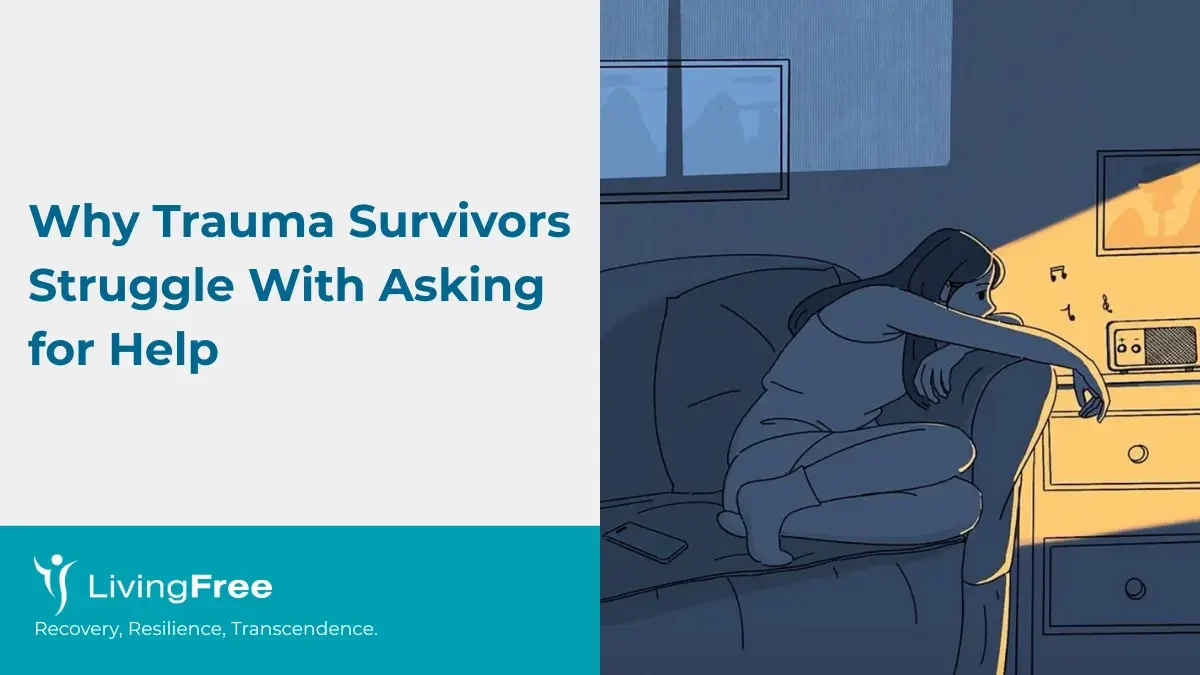
If you have ever needed support and found yourself saying “I’m fine” instead, you already know how strange this contradiction feels. Part of you wants someone to notice. Another part of you would rather collapse quietly than say the words out loud. This is one of the most common and least talked about patterns among people who have lived through trauma, and it is not a character flaw. It is a learned, protective response that once made sense and now gets in the way of healing.
Understanding why trauma survivors struggle with asking for help requires looking past willpower and into the nervous system, the stories survivors carry about themselves, and the real experiences that taught them help was not safe. Below is a closer look at what research and clinical experience tell us about this pattern, along with practical ways to begin softening it.
Table of Contents
Why the Body Says No Before the Mind Says Yes
Long before a person consciously decides whether to reach out, their nervous system has already made a judgment call. Psychiatrist Bessel van der Kolk has spent decades documenting how trauma changes the body’s baseline sense of safety, often compromising a person’s capacity for trust long after the danger has passed1. The body keeps reacting to old threats even in situations that are objectively safe today.
This is part of what researcher Stephen Porges describes through polyvagal theory. According to this framework, the nervous system runs a constant, unconscious background scan called neuroception, deciding whether a person or situation feels safe, dangerous, or life threatening, well before the thinking brain weighs in2. For someone whose history taught their body that closeness equals risk, even a kind offer of help can trigger the same physiological alarm as an actual threat.
In practice, this can look like:
- A racing heart or tight chest when picking up the phone to call a therapist
- A sudden urge to cancel plans right before opening up to someone
- Feeling foggy, frozen, or unable to find words in the moment support is offered
- Physically pulling away from comfort even while wanting it
None of this is a conscious choice. It is the body protecting itself using outdated information. This is also why patterns like difficulty trusting others or feeling disconnected in close relationships often trace back to how trauma shapes relationships, identity, and the way people connect long after the original event has ended.
As Dr. Reshie explains,
“Where the body goes, the mind will follow. And if the body is in a distress state… then the mind is going to, even if the mind is disconnected enough, eventually it will go there.”
Katrina echoed this idea from her own experience, describing how she ignored persistent physical warning signs for years before realizing that her body had been communicating distress all along. This perspective reinforces an important point: trauma responses are not simply “in your head.” They are deeply rooted in how the nervous system and body have learned to respond to danger.
Shame, Self-Blame, and the Inner Critic That Says You Don’t Deserve Support
Shame is one of the most consistent threads running through the research on trauma and help-seeking. Psychiatrist Judith Herman, whose work has shaped decades of trauma treatment, observed that traumatic experiences are fundamentally disempowering and isolating, and that shame, mistrust, and an imbalance of power often become central themes survivors carry into every relationship afterward, including the therapeutic one3.
This shame is rarely logical. A survivor of childhood neglect may believe they were too difficult to love. A survivor of assault may believe they should have prevented it. A combat veteran may believe needing help proves they are no longer capable. None of these beliefs are true, but they feel true, because shame distorts self-perception in ways that guilt does not.
Common shame-driven thoughts trauma survivors describe include:
- “Other people have it worse, I shouldn’t complain”
- “If I ask for help, people will finally see how broken I am”
- “I should be able to handle this on my own by now”
- “Needing support means I failed”
These thoughts often have a loud, persistent narrator attached to them. That inner voice, frequently rooted in early experiences of criticism or conditional love, tends to grow harsher rather than quieter when a person is struggling the most. Recognizing this pattern is the first step toward loosening its grip, and it helps to understand how the inner critic forms after trauma and why it gets so much louder right when support is needed most.
When Independence Becomes a Cage: Hyper-Independence and the Fawn Response
For many survivors, especially those who experienced chronic relational trauma in childhood, self-reliance was not a personality trait. It was survival. When caregivers responded to a child’s needs with dismissal, criticism, or harm, that child’s nervous system drew a clear conclusion: depending on others is dangerous. That conclusion does not disappear in adulthood just because the environment has changed.
Therapist Pete Walker, who specializes in complex trauma, expanded the traditional fight or flight framework into what he calls the four Fs: fight, flight, freeze, and fawn4. The fawn response in particular shows up as compulsive helpfulness, accommodation, and an inability to ask for anything in return, all developed to avoid rejection or conflict. Many survivors swing between fawning toward others’ needs and refusing to voice their own.
This pattern can show up as:
- Being the one everyone else leans on, while never reaching out yourself
- Feeling intense guilt after expressing a need, even a small one
- Equating self-sufficiency with safety, and dependence with weakness
- Burning out quietly rather than asking for relief
If this sounds familiar, it may be worth exploring whether people-pleasing has become a trauma response rather than simply a personality quirk. The same root pattern often drives other behaviors too. Many survivors channel their need for control and safety into constant achievement, which raises the question of whether overachieving is itself a trauma response, and why perfectionism so often develops alongside it. In fact, the link between trauma and perfectionism is well documented, since both offer a survivor a sense of control in a world that once felt unpredictable and unsafe.
A 2022 study examining help-seeking barriers among survivors of intimate partner violence found that nearly all participants described believing that needing help was a sign of weakness, and that this belief was one of the strongest predictors of staying silent, regardless of how much distress they were in5. In other words, this is not a rare quirk. It is one of the most common and stubborn barriers survivors face.
Why “I Don’t Want to Make It Worse” Keeps People Silent
Another major barrier is the fear that opening up will unleash something a person cannot control. Many survivors avoid thinking or talking about their experience specifically because they worry that doing so will flood them with emotions they will not be able to manage6. This is not avoidance for the sake of avoidance. It is an attempt to maintain stability the only way they know how.
This fear often includes worries such as:
- “If I start crying, I might not stop”
- “Talking about it will bring it all back”
- “I’ve kept it together this long by not touching it”
- “What if the person I tell can’t handle it either”
This concern is understandable, but it is also one of the most common misconceptions about trauma recovery. Many survivors are surprised to learn the actual research on whether talking about trauma makes it worse, since structured, paced support with a trained professional tends to reduce distress over time rather than amplify it. The federal Treatment Improvement Protocol on trauma-informed care notes that survivors generally do better when providers offer predictability, advance information, and a non-shaming response to distress, rather than rushing the process7. Safety, not speed, is what makes disclosure tolerable.
Broken Trust: When Asking for Help Has Backfired Before
For some survivors, the hesitation is not abstract. It is based on direct experience. They asked for help once, and it went badly. Maybe they were dismissed, blamed, disbelieved, or met with a response that made the situation worse. A systematic review of 36 studies on mental health service use among trauma survivors identified stigma, fear of judgment, and previous negative encounters with services as some of the most consistently reported barriers across both military and civilian populations6.
Mistrust shaped by past experience can look like:
- Assuming a new therapist will react the same way an old one, or a family member, did
- Testing people before opening up, to see if they can be trusted with more
- Avoiding formal systems entirely, such as healthcare or social services, after a prior bad experience
- Believing “no one will really understand” before even trying
This is also where the people around a survivor matter enormously. Loved ones, partners, and close friends who try to support a trauma survivor can themselves begin to feel the emotional weight of that experience, sometimes without realizing it. This is part of why understanding vicarious trauma matters, not just for clinicians but for anyone close to a survivor. Therapists, case workers, and first responders face a related challenge, often described through the lens of secondary trauma, which can unintentionally affect how present and steady they are able to be when a survivor finally does reach out.
The Practical and Systemic Barriers No One Talks About
It would be incomplete to frame this as purely psychological. Real, structural barriers stand between many survivors and the support they need, and these barriers compound the emotional ones.
Commonly reported practical obstacles include:
- Cost of therapy or limited insurance coverage for trauma-focused treatment
- Long waitlists or a shortage of trauma-trained providers in a given area
- Difficulty finding time away from work, caregiving, or other responsibilities
- Concern about confidentiality, especially in small communities or specific professions
- Past encounters with providers who lacked trauma-specific training
These barriers are not excuses. They are documented, recurring findings in the research on help-seeking, and they often interact with shame and mistrust to make the entire process feel insurmountable rather than simply inconvenient.
Recognizing the Signs in Yourself or in Someone You Love
Sometimes the struggle to ask for help is so deeply woven into daily functioning that it goes unnoticed for years. A person can function, succeed, and even appear unusually capable, all while quietly carrying more than they should have to alone. This is part of why so many people wonder about whether it’s possible to have PTSD without knowing it, since trauma responses can hide behind competence, busyness, or chronic self-sufficiency.
Signs worth paying attention to include:
- Consistently minimizing your own struggles compared to others
- Feeling responsible for everyone else’s wellbeing but not your own
- A pattern of withdrawing right when support is offered
- Physical symptoms of stress that have no clear medical cause
- A long-standing belief that needing people is risky or shameful
If several of these resonate, it does not mean something is wrong with you. It means your nervous system learned a survival strategy that has simply outlived its usefulness.
How to Begin Asking for Help When It Still Feels Unsafe
Rebuilding the capacity to ask for and receive support is gradual work, not a single decision. A few approaches that survivors and clinicians have found helpful include:
- Starting small, such as asking someone for a minor favor before attempting a larger disclosure
- Choosing one trustworthy person rather than trying to open up broadly all at once
- Working with a trauma-informed therapist who paces sessions according to your window of tolerance, not a script
- Naming the fear out loud, for example saying “this is hard for me to ask” before making the request
- Practicing self-compassion when the old urge to handle everything alone resurfaces
Progress here is rarely linear. There will be days when reaching out feels possible and others when it feels just as hard as it always has. Both are part of the process.
Final Thoughts
If you recognize yourself in any of this, please know that struggling to ask for help is not proof of weakness or brokenness. It is evidence of a nervous system, a set of beliefs, and a history that once required you to manage everything alone, sometimes just to survive. The goal of recovery is never to erase that resilience, but to give you more options than silence and self-reliance. Healing happens through connection, not despite it, which is exactly the work we focus on at livingfree.today.
If reading this stirred something in you, that is worth paying attention to rather than pushing aside. You do not have to figure out how to ask for help perfectly, and you do not have to do it alone. Contact us when you are ready, and let’s take the next step together.