
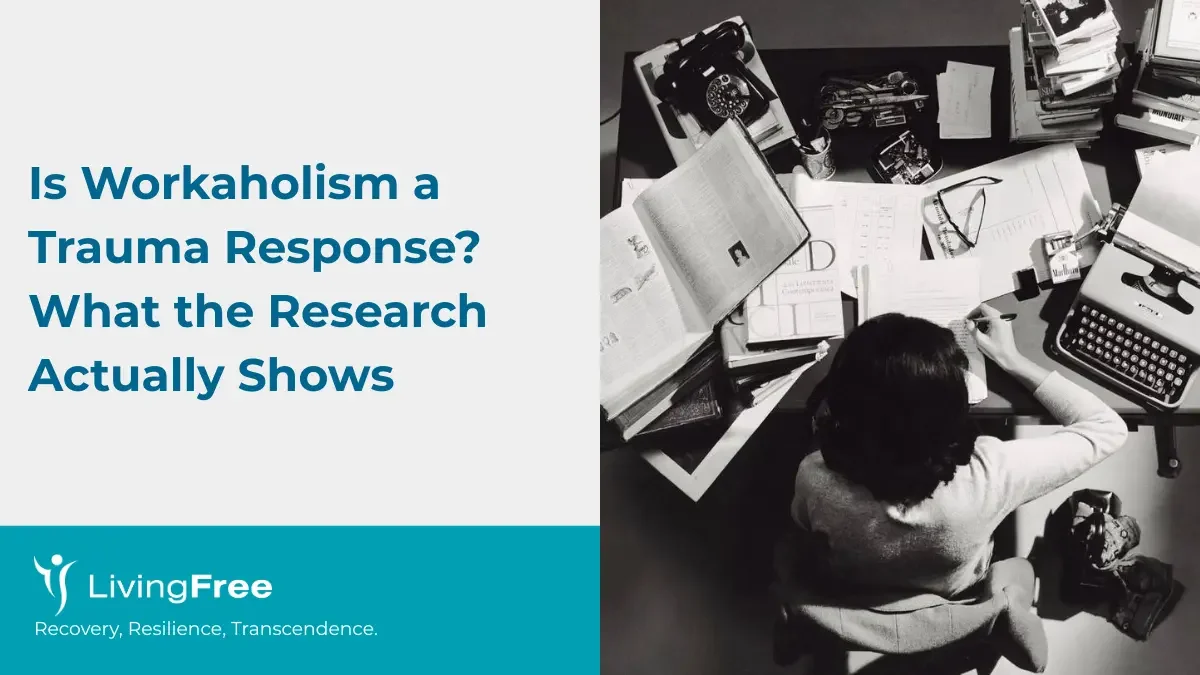
It is 11 p.m. and the inbox is still open. The to do list is finished, technically, but somehow there is always one more thing that feels urgent. For a lot of people who identify as driven, ambitious, or simply “someone who works hard,” this pattern gets read as a personality trait. Colleagues call it dedication. Family members call it a strong work ethic. But for a meaningful number of high performers, that inability to stop is not about loving the job. It is a nervous system doing exactly what it learned to do a long time ago.
Is workaholism a trauma response? The clinical and academic research increasingly says yes, at least for a substantial subset of people who overwork compulsively. Not every long hour at the office is trauma driven, and ambition is not automatically pathological. But a growing body of psychological literature ties compulsive overworking to early relational wounds, childhood emotional abuse, and a nervous system that has learned stillness is not safe.
Table of Contents
What Workaholism Actually Is, Clinically
Workaholism is not simply working long hours or being passionate about a career. Researchers define it as a compulsive relationship with work characterized by an inability to stop even when the person genuinely wants to, distress when not working, and continued overwork despite the toll it takes on health and relationships.
Work addiction is now commonly studied through the lens of behavioral addiction rather than personality or work ethic. The Bergen Work Addiction Scale, developed by Norwegian researchers, measures workaholism using the same seven core components used to define substance addiction: salience, mood modification, tolerance, withdrawal, conflict, relapse, and problems. In other words, work can occupy the same psychological territory as alcohol, gambling, or any other compulsive behavior.
A few patterns show up consistently in the research:
- Work becomes the dominant thought throughout the day, even during time meant for rest or family (salience)
- Working produces a mood shift, often relief or a sense of calm, that other activities cannot replicate (mood modification)
- Over time, more hours or higher stakes are needed to get the same sense of relief (tolerance)
- Stopping produces anxiety, irritability, or emptiness (withdrawal)
- Attempts to cut back fail repeatedly, and work continues to cause problems in relationships or health despite that awareness
This addiction framework matters because it shifts the question away from willpower. As physician and addiction researcher Gabor Mate has argued, addiction is rarely about the substance or behavior itself. It is about the function that behavior serves in managing emotional pain. Applied to work, the question becomes less about time management and more about what the constant motion is protecting a person from feeling.
The Trauma Connection: What the Studies Are Finding
The link between early adversity and compulsive overwork is not just anecdotal anymore. A 2024 study published in the journal Behavioral Sciences examined 1,176 young workers and found that childhood emotional abuse had both a direct relationship with adult workaholism and an indirect one, operating through neuroticism and perfectionism. The researchers concluded that identifying childhood emotional abuse early and using trauma informed approaches could help prevent the development of work addiction later in life.
This tracks with what trauma researchers have described for decades. Psychiatrist Judith Herman, in her foundational text Trauma and Recovery, describes how chronic relational trauma in childhood produces an adaptive reorganization of the self, one in which a child learns to monitor, anticipate, and perform rather than simply exist. That adaptation does not disappear in adulthood. It often becomes the operating system underneath an adult’s relationship to achievement.
A few specific developmental patterns show up again and again in the literature connecting childhood experience to adult work addiction:
- Parentification. This is the reversal of the parent child role, where a child becomes the emotional or practical caretaker of a parent who cannot fulfill that role themselves. Research comparing adult children of workaholic and alcoholic parents found that both groups reported significantly higher levels of parentification and depression than a control group. Adults who were parentified as children often carry an unconscious belief that if they work hard enough, everyone around them will finally be steady.
- Conditional worth. When a child’s value in the family is tied to performance, achievement, or usefulness rather than simply being present, that child can grow into an adult whose entire sense of safety depends on output.
- Emotional neglect or abuse. Even without a single dramatic incident, an environment where emotional needs are consistently minimized or dismissed can wire a nervous system to associate stillness with danger and productivity with control.
If any of this sounds familiar, it may be worth exploring how childhood trauma and perfectionism in adulthood are connected, since perfectionism and overwork frequently travel together.
Why the Body Chooses Work
Trauma responses are usually described through the lens of fight, flight, freeze, or fawn. Workaholism tends to map most closely onto flight, a state of constant forward motion that keeps the nervous system one step ahead of feelings that seem too overwhelming to face directly.
Chronic overwork keeps the sympathetic nervous system activated for extended periods. Over time, this sustained activation has been linked to elevated cortisol, disrupted sleep, immune suppression, and cardiovascular strain. The body essentially treats an inbox the way it would treat an actual threat, staying braced and alert long after any real danger has passed.
There is also a practical logic to why work, specifically, becomes the coping mechanism of choice for so many trauma survivors:
- Work offers a socially rewarded outlet. Unlike other compulsive behaviors, overworking is praised rather than questioned.
- It provides a sense of control in a life that once felt unpredictable or unsafe.
- It creates structure, which can feel protective for a nervous system organized around monitoring and managing outcomes.
- It postpones the need to sit with unresolved feelings, since there is always another task to move toward.
This is part of why workaholism can be harder to recognize and interrupt than other unhealthy coping mechanisms for trauma. Nobody stages an intervention for someone who works too much. If anything, that person gets promoted.
Workaholism, Overachievement, and the High Performer Trap
There is significant overlap between workaholism and what is often called overachievement, the pattern of chronically exceeding expectations as a way to secure safety, approval, or a stable sense of self. Many of the same childhood roots apply, including conditional love, parentification, and an early lesson that being exceptional was the price of being accepted.
It can be genuinely difficult to tell the difference between ambition and compulsion from the outside, and sometimes even from the inside. A few distinctions tend to hold up:
- Genuine ambition tends to coexist with rest. Trauma driven overwork treats rest as unbearable, not just inconvenient.
- Ambition is generally flexible. Compulsive work continues even when it is actively damaging health, relationships, or the original goal.
- Ambition is usually connected to a clear internal sense of purpose. Compulsive overwork is often driven by an attempt to outrun an internal state, whether that is anxiety, emptiness, or a fear of being seen as not enough.
For a deeper look at how this shows up specifically, the article on whether overachieving is a trauma response walks through the pattern in more detail.
How Trauma Driven Workaholism Shows Up in Relationships
Compulsive overwork rarely stays contained to a job. It tends to bleed into how a person shows up with the people closest to them.
People whose nervous systems learned safety through performance often struggle to be emotionally present once the productivity stops. Partners describe feeling like they are competing with a laptop. Children describe a parent who is physically home but never fully arrived. Friendships quietly erode because there is never enough unstructured time to sustain them.
Some of the relational patterns that tend to accompany trauma driven workaholism include:
- Difficulty being fully present during downtime or vacations
- Using busyness as a way to avoid conflict or emotionally difficult conversations
- A tendency toward people pleasing at work, paired with distance or irritability at home
- Struggling to receive care or support from others, since the identity has been built around being the one who provides
These patterns connect closely to broader research on how trauma affects communication styles, since a nervous system trained to perform rather than connect often communicates in ways that keep real intimacy at arm’s length. It also relates to the well documented link between people pleasing, avoidance, and the fear of conflict, since many workaholics are, underneath the achievement, deeply conflict avoidant. Over time, this can reshape how trauma shapes relationships, identity, and the way a person connects with everyone around them, not just coworkers.
The Cost of Staying in Motion
Karoshi, a Japanese term that translates roughly to death by overwork, is an extreme but real endpoint of a culture that rewards compulsive productivity. Most cases of workaholism will not reach that point, but the health toll of chronic overwork is well documented.
A large systematic review examining burnout among physicians analyzed data from 182 studies covering more than 109,000 individuals across 45 countries and found overall burnout prevalence ranging widely depending on definition and setting, underscoring just how common and how variable the toll of achievement driven overwork can be. Separately, research into work addiction using the Bergen Work Addiction Scale in a Danish sample found that people at high risk of work addiction reported significantly higher perceived stress and meaningfully lower quality of life compared to those at low risk.
Common costs associated with trauma driven workaholism include:
- Chronic fatigue and burnout that does not resolve with a vacation
- Strained or distant relationships with partners, children, or friends
- Physical symptoms including disrupted sleep, digestive issues, and cardiovascular strain
- A persistent, low grade sense that nothing achieved is ever quite enough
What Healing Actually Looks Like
Recovery from trauma driven workaholism is not a productivity problem, so it cannot be solved with a better morning routine or a more efficient calendar. Time management strategies tend to function as sophisticated defenses, a way to maintain control rather than actually address what the compulsion is protecting against.
Real healing tends to involve a few consistent elements:
- Naming the pattern without shame. Recognizing overwork as an adaptation rather than a character flaw removes some of the shame that keeps people stuck in it.
- Building tolerance for stillness. This often means gradually, gently increasing a person’s capacity to sit with quiet or unstructured time without immediately filling it.
- Addressing the underlying wound. Trauma informed therapy, including approaches that work somatically with the nervous system, can help process the original experiences that made performance feel like the only path to safety.
- Practicing healthier coping strategies. Replacing constant work with genuinely regulating activities, connection, and rest helps retrain the nervous system over time. This is where it helps to understand what healthy coping mechanisms for trauma actually look like, since many workaholics have simply never had a model for what regulation without achievement feels like.
- Rebuilding relationships. Since workaholism often damages connection with others, healing usually includes intentional repair with partners, family, and friends who have been affected by the pattern.
None of this happens quickly, and it rarely happens alone. A pattern built over years or decades of adaptation deserves patience, and professional support, rather than another item on a to do list.
Final Thoughts
Workaholism is not a moral failing, and it is not simply the price of being ambitious. For many high achievers, it is the clearest evidence of how resourceful a young nervous system can be when it is trying to stay safe in an environment that made stillness feel dangerous. Recognizing that pattern is not about giving up on hard work or meaningful goals. It is about finally getting to choose them, rather than being driven by them. If any part of this resonates, exploring trauma informed support through a resource like livingfree.today can be a helpful next step toward understanding what is really underneath the busyness.
Healing is possible, and it does not require dismantling everything a person has built. It requires understanding the nervous system that built it, and giving that system new evidence that rest and connection are safe too. If this article raised questions about your own relationship to work, or someone you care about, please contact us. Support is available, and no one has to untangle this alone.