
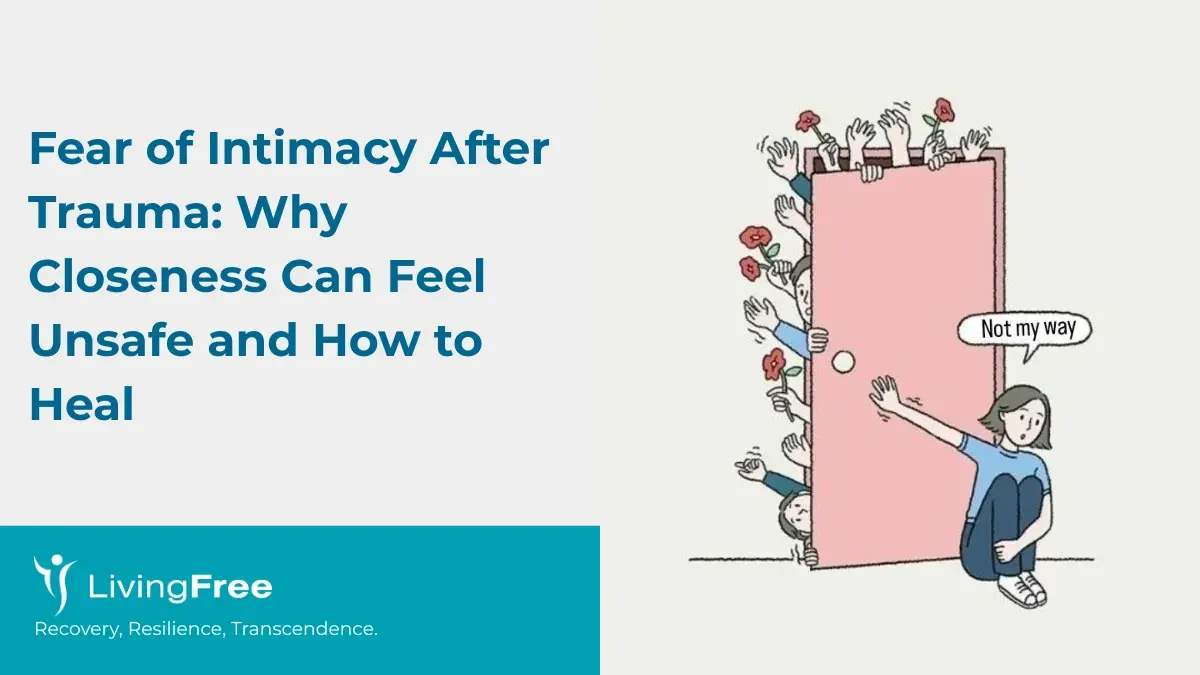
Wanting to be close to someone and feeling terrified of that same closeness can exist in the same body at the same moment. This is one of the more confusing experiences for trauma survivors. You may long for a partner who understands you, and still find yourself pulling away the second things start to feel real. You might crave touch and also flinch from it. You might rehearse conversations you never have the courage to start.
Fear of intimacy after trauma is not a personality flaw, a lack of effort, or a sign that you are unlovable. It is a survival response that made sense at one point in your life and has simply not caught up with the fact that you are safer now. Understanding where this fear comes from, how it shows up in daily life, and what actually helps can make the difference between staying stuck in the same pattern and finally moving through it.
Table of Contents
What Fear of Intimacy After Trauma Really Means
Fear of intimacy, sometimes called intimacy avoidance, describes a pattern where someone wants closeness but pulls back whenever a relationship starts to deepen. Researchers studying this pattern have described it as apprehension about becoming emotionally close to important people, even when the desire for that closeness is genuine and strong. This is not limited to romantic partners. It can affect friendships, family relationships, and even connections with colleagues, since the fear centers on vulnerability itself rather than any one type of relationship.
Trauma does not have to involve a single catastrophic event to create this pattern. It can come from:
- Childhood neglect or emotionally unavailable caregivers
- Sexual abuse or assault, at any age
- Domestic violence or coercive control in a past relationship
- The sudden loss of a significant person
- Betrayal, infidelity, or repeated broken trust
- Growing up in a household marked by conflict, addiction, or unpredictability
A recent study examining childhood trauma and fear of intimacy found that the connection between the two was fully explained by mentalization, which is a person’s capacity to understand their own mental states and accurately read the mental states of others (Karimzadeh et al., 2024). In other words, trauma does not create fear of intimacy directly. It disrupts the internal skill needed to feel safe interpreting another person’s intentions, and that disruption is what makes closeness feel risky.
Why the Body Reacts to Closeness Like a Threat
When a traumatic event occurs, the body shifts into a survival state involving fight, flight, freeze, or fawn responses. For many survivors, this state never fully resolves. Instead, the nervous system stays on alert, ready to detect danger even in situations that are objectively safe, such as a loving partner reaching for your hand.
This is where the concept of neuroception becomes useful. Neuroception is the nervous system’s automatic, unconscious scanning process that determines whether a person, place, or situation is safe or dangerous, a concept introduced through polyvagal theory (Porges, 2011). This scanning happens beneath conscious thought. That is why someone can logically know their partner is trustworthy and still feel their chest tighten or their body freeze when that partner leans in for a hug.
This disconnect between what the mind knows and what the body experiences is something many trauma therapists observe in practice. As Living Free Clinical Director Dr. Reshie Joseph explains,
“Whoever said ‘mind over matter’ had it exactly the wrong way around. It’s actually matter over mind… Where the body goes, the mind will follow. If the body is in a distress state, then the mind eventually will go there too.”
Katrina, a trauma therapist at Living Free, agreed, noting that her own recovery began only after she understood
“the connection between the mind and the body”
rather than trying to think her way through distress.
According to polyvagal theory, the nervous system moves through a hierarchy of states:
- A state of safety and social engagement, where connection, warmth, and eye contact feel comfortable
- A mobilized fight or flight state, activated when the body senses threat and prepares to defend or escape
- A shutdown or freeze state, the body’s oldest survival response, used when fighting or fleeing feels impossible
For a trauma survivor, ordinary intimacy cues, a certain tone of voice, a specific type of touch, being looked at for too long, can trigger the same nervous system response that once protected them from real danger. The body is not overreacting. It is doing exactly what it was trained to do. This dynamic is explored further in how trauma affects communication styles, since the same nervous system responses that disrupt intimacy also shape how survivors express needs or shut down mid conversation.
Attachment Patterns Shaped by Trauma
Attachment theory offers one of the clearest explanations for why trauma and fear of intimacy are so closely linked. Our earliest relationships, particularly with caregivers, teach us whether closeness is safe or dangerous, and those early lessons often continue shaping adult relationships long after the original relationship has ended.
Research on interpersonal trauma among psychiatric inpatients found that trauma was significantly correlated with attachment avoidance, and that this avoidance partially explained the connection between trauma and anxiety symptoms (Zamir et al., 2015). A separate analysis of adults with high adverse childhood experience scores found that those individuals were more likely to report difficulty with emotional closeness, fear of abandonment, avoidance of intimacy, and challenges trusting others, compared to those with lower adverse childhood experience scores (Relational Consequences of Childhood Trauma, 2025).
Three attachment patterns tend to show up most often after trauma:
- Anxious attachment. A strong desire for closeness paired with an intense fear of abandonment, often accompanied by a need for constant reassurance
- Avoidant attachment. A tendency to prioritize independence, suppress emotional needs, and keep partners at a distance to avoid feeling exposed
- Disorganized (fearful avoidant) attachment. A push and pull pattern where someone simultaneously seeks closeness and fears it, often rooted in a childhood where caregivers represented both comfort and threat
Disorganized attachment is particularly linked to complex trauma and tends to produce the most confusing internal experience, since the same person who is craved for comfort is also the one the nervous system flags as dangerous. This tension is a central theme in why trauma shows up most in close relationships, where the safest relationships often become the ones that trigger the strongest trauma responses.
Common Signs of Fear of Intimacy After Trauma
Fear of intimacy does not always look like obvious avoidance. It often hides behind behavior that seems unrelated to fear at all. Common signs include:
- Withdrawing emotionally or physically as soon as a relationship starts to feel serious
- Struggling to identify or name emotions during moments of closeness
- Feeling numb, distant, or checked out during physical touch or sex
- Picking fights or creating distance right after a moment of vulnerability
- Over functioning as a partner while avoiding your own emotional needs
- Difficulty trusting a partner’s intentions, even without evidence of dishonesty
- Feeling an urge to end relationships once they start to feel meaningful
- Physical symptoms such as a racing heart, shallow breathing, or muscle tension when someone gets emotionally or physically close
These patterns can look different depending on gender and cultural background. Some research notes that cultural expectations discourage men from discussing fear or emotional pain, while women may internalize trauma symptoms in ways that make emotional closeness feel harder to access or express. Neither experience is more valid than the other. Both reflect a nervous system trying to manage overwhelming feelings the only way it currently knows how.
How Sexual Trauma Shapes Physical Intimacy
Sexual trauma has a particularly direct impact on physical closeness, since intimacy itself was the context in which the violation occurred. Clinicians have identified two broad patterns that can emerge after sexual trauma. A hypo-sexual response is marked by fear, avoidance, and a preference for emotional over physical closeness. A hyper-sexual response involves an unconscious attempt to regain control by re-engaging with sexual situations, sometimes through frequent or disconnected encounters. Both patterns share a common thread, an attempt to regain a sense of control over a body that once had control taken from it.
Common physical and emotional responses reported by survivors of sexual trauma include:
- Avoiding, fearing, or losing interest in sex altogether
- Approaching sex as an obligation rather than a source of connection or pleasure
- Feeling anger, disgust, or guilt in response to touch
- Difficulty becoming aroused or feeling physical sensation
- Feeling emotionally distant or dissociated during intimacy
- Experiencing intrusive or distressing sexual thoughts or images
These reactions are widely documented among survivors and reflect the body’s attempt to protect itself, not a lack of love for a partner or a personal failing. Reconnecting with physical intimacy after this kind of trauma tends to take longer than reconnecting emotionally, and that timeline deserves patience rather than pressure.
The Push and Pull of Wanting Connection While Fearing It
One of the most disorienting parts of fear of intimacy is the contradiction at its center. Most people, including trauma survivors, are wired to seek connection. Emotional attachment and physical affection are fundamental to human wellbeing. Yet for someone whose nervous system associates closeness with danger, that same connection can trigger anxiety, withdrawal, or conflict instead of comfort.
This creates a cycle: closeness triggers fear, fear triggers distancing behavior, distancing behavior creates loneliness, and loneliness reignites the desire for closeness. Understanding this cycle as a nervous system pattern, rather than a character flaw, is often the first real turning point in healing. Recognizing your own version of this pattern is closely tied to recognizing trauma triggers in relationships, since the moments that spark withdrawal are rarely random.
Pathways That Help Survivors Rebuild Intimacy
Fear of intimacy after trauma is treatable, and healing tends to follow a specific order. Establishing a felt sense of safety comes first, because no communication technique or relationship exercise works while the nervous system still perceives closeness as dangerous. Several therapeutic approaches have shown particular value for this work.
- Eye Movement Desensitization and Reprocessing (EMDR). This approach helps the nervous system reprocess traumatic memories without requiring a person to describe the event in detail, which makes it especially useful for survivors of abuse or assault who find talk therapy alone overwhelming
- Somatic therapy. Since trauma is stored physically as well as psychologically, body based approaches help release stored tension and rebuild a felt sense of safety in physical sensation and touch
- Mentalization based approaches. Since research points to mentalization as the mechanism linking childhood trauma to fear of intimacy, therapies that strengthen a person’s ability to understand their own and others’ mental states can directly target the root of the fear rather than only its symptoms
- Attachment focused and couples work. This helps partners understand each other’s nervous system responses and build new, corrective relational experiences over time
Rebuilding trust and safety in attachment is rarely instant. It develops through repeated small moments of vulnerability that are met with care rather than harm, gradually teaching the nervous system a new lesson. This kind of rebuilding is described in more depth in what secure attachment feels like after trauma, and complements the practical strategies covered in ways to build healthier relationships while living with hyperarousal.
Practical Ways to Rebuild Trust and Closeness
Alongside professional support, there are ways to gently work with fear of intimacy in daily life. These are not quick fixes, but they can support the pace at which trust rebuilds.
- Practice naming what you are feeling in the moment, even if the only honest answer is I do not know yet
- Communicate your pace to a partner directly rather than withdrawing without explanation
- Use grounding techniques such as slow breathing or noticing physical sensations when closeness starts to feel overwhelming
- Build intimacy gradually through non sexual touch, shared activities, and consistent small moments of connection before expecting depth
- Notice when you are testing a partner to see if they will leave, and consider naming that pattern out loud instead of acting it out
- Allow repair after conflict rather than assuming distance is the only option
Progress with fear of intimacy rarely looks dramatic. It tends to look like staying present for one more minute than you would have last year, or naming a fear instead of acting it out. How trauma shapes relationships, identity, and the way we connect offers a broader look at how these small shifts accumulate into lasting change over time.
Final Thoughts
Fear of intimacy after trauma can feel like a permanent barrier between you and the connection you want, but it is a pattern that can shift once the nervous system learns, through repeated experience, that closeness does not have to mean danger. Healing is rarely linear, and understanding why relationships feel so hard after trauma is often the first step toward treating yourself with more patience along the way. At livingfree.today, this work is approached from both the psychological and physiological sides of trauma recovery, recognizing that lasting change happens in the body as much as in the mind.
If fear of intimacy is affecting your relationships, your sense of connection, or your ability to feel safe with the people you care about, you do not have to work through it alone. Contact us to learn more about trauma informed approaches that can help you rebuild trust, safety, and closeness at a pace that respects where your nervous system actually is.