
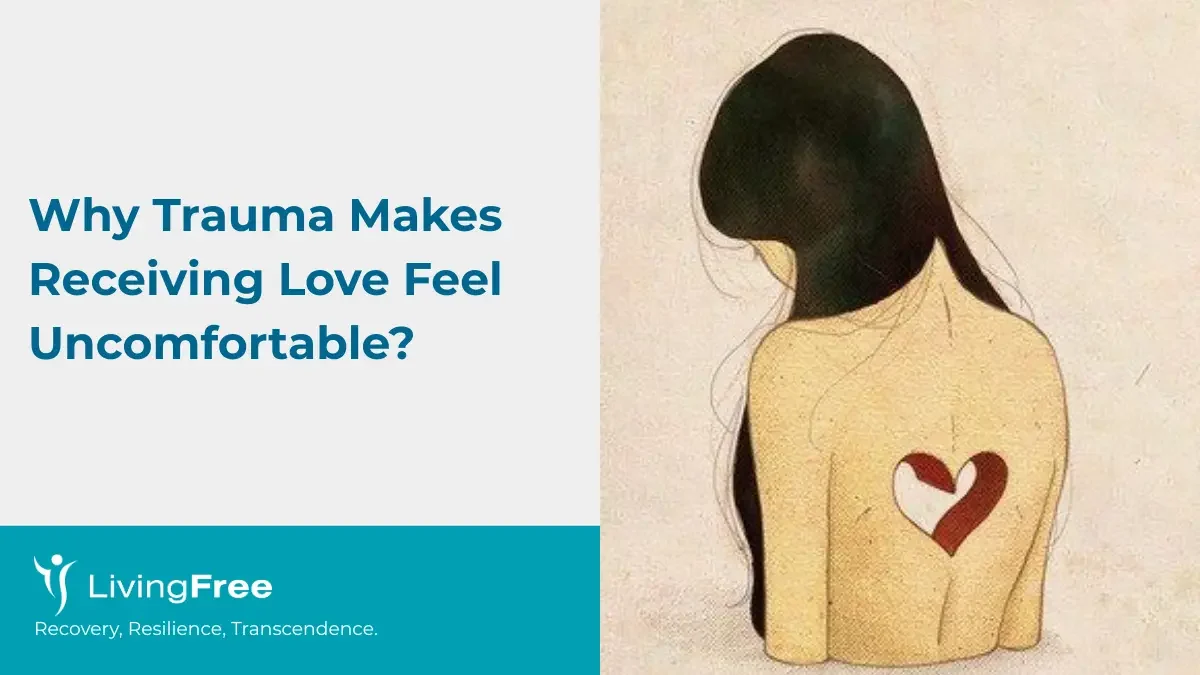
Love is supposed to feel like relief. For someone carrying unresolved trauma, it can feel like the opposite. A partner’s kind words land strangely. A hug lasts a second too long and something inside quietly recoils. Compliments get deflected, affection gets questioned, and the very thing a person has been longing for starts to feel like pressure instead of comfort.
This is not a character flaw and it is not a sign that someone is incapable of love. It is a survival adaptation. When the body has learned, often very early in life, that closeness can be unpredictable or unsafe, it builds defenses to protect against being hurt again. Those defenses do not simply switch off once a person meets someone kind. They have to be unlearned, slowly, through repeated experiences of safety.
Table of Contents
The Nervous System Decides Before the Mind Does
Long before a person consciously evaluates whether a relationship is safe, their nervous system has already made a judgment call. Researchers call this process neuroception, a term introduced by Dr. Stephen Porges to describe the body’s constant, subconscious scanning for cues of safety or danger (Porges, 2022). This scanning happens beneath awareness. It reads tone of voice, facial expressions, proximity, and timing, and it decides in a fraction of a second whether to relax or brace.
For someone whose nervous system was shaped by trauma, this internal alarm system tends to misfire. A neutral expression can be read as rejection. A partner’s silence can be interpreted as anger. Even something as ordinary as being told “I love you” can trigger a stress response rather than a calming one, because closeness itself has been coded as risk (Porges, 2011). This is part of why people living with hyperarousal often describe love as exhausting rather than soothing; their body is working overtime to detect danger in a moment that is actually safe. For a deeper look at what that experience feels like day to day, this piece on ways to build healthier relationships while living with hyperarousal breaks down practical strategies for calming an overactive threat response.
What makes this especially confusing is the mismatch it creates. A person can want love with their whole heart and still feel their body pull away from it. That contradiction, wanting closeness and fearing it at the same time, is one of the most disorienting parts of trauma recovery.
This disconnect between what the mind wants and what the body experiences is something trauma therapists observe repeatedly in clinical practice. As Dr. Reshie explains,
“Whoever said it’s mind over matter had it exactly the wrong way around. It’s actually matter over mind… where the body goes, the mind will follow. And if the body is in a distress state… the mind is going to go there.”
Katrina echoes this from her own experience, describing how she spent years “living very much in my mind” while her body was sending constant signals that something was wrong. Their conversation highlights why healing often begins with helping the nervous system feel safe, rather than trying to reason away fear through willpower alone.
Why Closeness Gets Coded as Danger
Trauma rewires the meaning of intimacy, particularly when the trauma was relational in nature. Neglect, abuse, abandonment, and chronic emotional unavailability all teach the same underlying lesson: the people who were supposed to keep you safe were also a source of harm or unpredictability. When that lesson is learned in childhood, it becomes the template the nervous system uses for every close relationship that follows.
This shows up in a few recognizable ways:
- Vulnerability starts to feel like exposure rather than connection, so being truly seen by someone can feel more threatening than comforting.
- Kindness can trigger suspicion, because the brain has learned to ask “what does this person want from me” before it asks “how nice is this.”
- Affection can feel conditional, so even secure love gets tested, questioned, or quietly braced against.
- Emotional closeness can register as more activating than calming, flipping the usual order of what should feel safe versus unsafe.
Trauma does not just change what a person is afraid of. It changes how they process love itself, and it often does this without the person realizing it is happening. This is one reason trauma tends to surface most intensely in a person’s closest relationships rather than in casual ones, since intimacy is exactly where the old wounds get activated. The article on why trauma shows up most in close relationships goes further into why proximity, not distance, tends to be what triggers old survival responses.
The Attachment Research Behind the Discomfort
This is not just a clinical theory. It has been studied directly. A 2024 study published in Frontiers in Psychiatry examined the relationship between childhood trauma and romantic relationship satisfaction in adulthood and found that childhood trauma negatively predicted satisfaction in adult relationships, largely through its effect on attachment security. The same research pointed to earlier findings that childhood emotional and physical neglect significantly predicts a heightened fear of intimacy later in life.
A separate 2024 study published in the International Journal of Environmental Research and Public Health looked specifically at how childhood emotional abuse leads to fear of intimacy in adulthood. The researchers found that insecure attachment styles, both anxious and avoidant, acted as the bridge between early emotional abuse and adult difficulty with closeness. In other words, the abuse itself did not directly cause the fear. It reshaped attachment patterns, and those patterns are what made intimacy feel unsafe years later.
Older research backs this up as well. A study following Holocaust survivors who had experienced trauma as children found that posttraumatic stress symptoms were directly associated with a measurable fear of intimacy decades later, showing just how long these patterns can persist without intervention (Cohen, Dekel, Solomon, & Lavie, 2003).
A few consistent findings run through this body of research:
- Insecure attachment, not trauma exposure alone, is usually the mechanism that connects early wounds to adult struggles with receiving love.
- Fear of intimacy is not limited to romantic partners. It can affect friendships, family relationships, and even the therapeutic relationship.
- The fear tends to center on being truly known, since sharing personal thoughts and feelings with someone who matters is often the hardest part, not the relationship itself.
Understanding this research matters because it reframes the discomfort. It is not proof that someone is broken or unlovable. It is evidence of a nervous system and an attachment system that adapted to protect a younger version of that person, and those adaptations simply have not caught up to the present. This is part of the larger picture of how early experiences shape adult identity and connection, which is explored in more depth in how trauma shapes relationships, identity, and the way we connect.
When the Mind Wants Love but the Body Resists
One of the more painful parts of this experience is the split between cognitive understanding and physical response. Someone can intellectually know that their partner is safe, kind, and trustworthy. They can want the relationship to work with complete sincerity. And their body can still brace, flinch, or shut down when love is offered.
This happens because trauma responses live largely in the limbic system and the autonomic nervous system, not in conscious thought. A person can be making every effort to trust, and their physiology can still be running an old survival program underneath that effort. The result is a kind of internal split: a mind that wants connection and a body that has not yet learned it is allowed to relax into it.
This split tends to show up differently depending on a person’s dominant coping pattern:
- Some people respond to this by becoming hyperaware of their partner’s every mood shift, overcorrecting to prevent any possibility of conflict or distance.
- Others respond by pulling away just as things start to deepen, ending relationships or creating distance right when intimacy is within reach.
- Some do both at different points, moving between craving closeness and fleeing from it depending on how safe the moment feels.
None of these patterns are chosen consciously. They are protective strategies that made sense at some point, even if they now create the very disconnection a person is trying to avoid.
Anxious and Avoidant Patterns in Receiving Love
Attachment style plays a major role in how this discomfort actually plays out day to day. People with an anxious attachment pattern often struggle to believe love is real or lasting, so they may seek constant reassurance, interpret small changes in tone as rejection, or feel unable to relax even in a stable relationship. People with an avoidant attachment pattern often struggle with the vulnerability that receiving love requires, so they may deflect affection, minimize their own needs, or create distance right when a relationship starts to feel significant.
Neither pattern is a personal failing. Both are adaptive responses to earlier environments where closeness was inconsistent, conditional, or unsafe. Recognizing which pattern feels most familiar is often the first practical step toward change, since it is difficult to interrupt a response a person cannot yet name. For a clearer picture of what healing this actually looks like once these patterns start to shift, what secure attachment feels like after trauma offers a grounded description of that process.
How Communication Gets Tangled Up in the Discomfort
Receiving love does not happen in a vacuum. It happens through communication, through the small daily exchanges of affection, reassurance, and attention that make up a relationship. Trauma can distort this exchange in both directions.
- A person may struggle to name what they need, making it harder for a partner to offer love in a way that actually lands.
- Emotional triggers can hijack ordinary conversations, turning a minor disagreement into a moment that feels like confirmation of old fears.
- Defensive communication patterns, like criticism, withdrawal, or shutting down, can develop as a way to keep intimacy at a manageable distance.
These patterns are not about a lack of love. They are about a communication style that was shaped under conditions where openness was not always safe. Untangling this is often just as important as addressing the underlying trauma itself, and it is covered in detail in how trauma affects communication styles, which walks through how these patterns form and how they can be gradually shifted.
Why the Discomfort Does Not Mean Something Is Wrong
It is worth saying plainly that finding love uncomfortable after trauma is not evidence of being unlovable, broken, or destined to sabotage every relationship. It is evidence of a nervous system that learned, accurately, that vigilance kept it safer in the past. That system is simply applying an old rule to a new situation.
A few things tend to help people begin shifting this pattern over time:
- Consistency from a partner or support system, since predictability is one of the fastest ways to teach a dysregulated nervous system that it can lower its guard.
- Therapy approaches that work with the body, not just the mind, including somatic therapy and EMDR, since trauma responses live in the nervous system as much as in memory.
- Practicing small moments of receiving, like accepting a compliment without deflecting it, which slowly retrains the automatic urge to reject or minimize affection.
- Building self-compassion, since much of the discomfort around receiving love is tied to an underlying belief of being undeserving of it.
Healing is rarely linear. Someone can have a breakthrough moment of feeling safe and loved, followed by a week of unexplained distance or irritability as the nervous system processes the unfamiliar experience of closeness. This back and forth is part of the process, not a sign that it is failing.
Final Thoughts
Discomfort with receiving love is one of the clearest signs that trauma is still living in the body, not just in memory. It shows up as flinching at kindness, deflecting compliments, or feeling an unexplained urge to create distance right when a relationship starts to feel good. Understanding why this happens, through the lens of nervous system safety, attachment patterns, and communication, takes away the shame that so often surrounds it and replaces it with something far more useful: a starting point for change.
At livingfree.today, this is the kind of work at the center of everything shared, helping people understand their trauma responses and build the kind of safety that allows love to finally feel like relief instead of a threat. Healing this pattern takes time, support, and often professional guidance, and no one has to sort through it alone. If this resonates with your own experience or someone you care about, contact us to learn more about how trauma-informed support can help.