
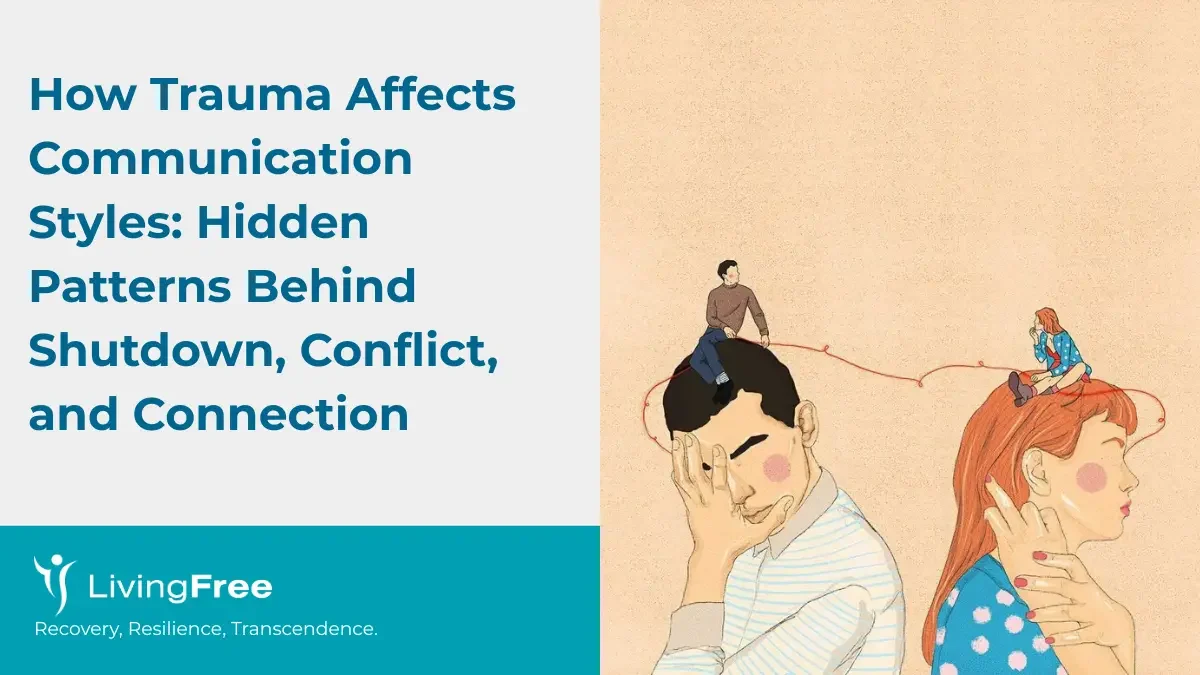
Maybe you have watched someone go completely silent in the middle of an argument, as if the words just stopped coming. Maybe you are the one who apologizes before you even know what you are apologizing for, or the one who talks faster and faster when a conversation starts to feel unsafe. None of this is random. How trauma affects communication styles is one of the most consistent findings in trauma research, and it explains why so many capable, intelligent people still struggle to say what they mean when it matters most.
Communication is not just a set of social skills. It is a nervous system event. Long before a person chooses their words, their body has already decided whether the room feels safe enough to speak freely in. For survivors of trauma, whether that trauma was a single overwhelming event or years of chronic stress in childhood, that internal safety calculation often gets miscalibrated. The result shows up in conversation: shutting down, lashing out, over-explaining, people pleasing, or going blank at exactly the moment words are needed most.
Table of Contents
The Nervous System Sets the Tone Before a Word Is Spoken
According to polyvagal theory, developed by neuroscientist Stephen Porges, the autonomic nervous system is constantly scanning the environment for cues of safety or danger through a process called neuroception. This scanning happens below conscious awareness, and it directly shapes whether a person can access calm, connected speech or whether their body shifts into a defensive state instead (Porges, 2022).
This is why trauma survivors often react strongly to things that seem minor to everyone else. A slightly sharp tone, a crossed arm, a pause before someone answers a question. These small signals get picked up by a nervous system that has learned, often through painful experience, to treat ambiguous cues as potential threats. Some of the signals the body reads instantly, before a single word registers consciously, include:
- Tone and volume of voice, including how quickly it shifts
- Facial expression and the tightness or softness around the eyes and mouth
- Pace and rhythm of speech, since rushed or clipped speech can feel threatening
- Body posture and how much physical space someone takes up
- Eye contact, or the sudden lack of it
This is the deeper layer behind how trauma shapes relationships, identity, and the way we connect with other people. Communication style is rarely just a personality trait. It is the visible surface of a nervous system trying to keep a person safe.
This connection between the body and communication is something clinicians also see in practice. As Dr. Reshie explains:
“I often say to people that whoever said it’s mind over matter had it exactly the wrong way around. It’s actually matter over mind… Where the body goes, the mind will follow. And if the body is in a distress state… then the mind is going to go there.”
Katrina echoed this from her own experience, describing how learning about the mind-body connection became a turning point in her healing after years of ignoring what her body had been trying to communicate.
Speechless Terror: When the Brain’s Language Center Goes Offline
One of the most striking discoveries in trauma research comes from neuroimaging studies conducted by psychiatrist Bessel van der Kolk. When trauma survivors were asked to recall their traumatic memories while inside a brain scanner, researchers observed a sharp drop in activity in Broca’s area, the region of the brain responsible for translating personal experience into spoken language. At the same time, activity surged in the right hemisphere structures tied to emotional and sensory processing (van der Kolk, 1998).
In plain terms, this means the part of the brain that produces words can temporarily shut down during intense emotional activation, while the part of the brain that holds raw sensation and fear stays fully switched on. This is sometimes described as speechless terror, and it explains experiences such as:
- Going completely blank in the middle of a difficult conversation
- Knowing exactly how you feel but being unable to find the right words
- Speech that becomes scrambled, repetitive, or disorganized under stress
- A long delay between being asked a question and being able to answer it
This is not a matter of intelligence, effort, or willingness to communicate. It is a measurable shift in brain function that happens when the nervous system perceives enough threat. Understanding this can remove a tremendous amount of shame for people who have spent years assuming something was wrong with them simply because they could not always speak clearly under pressure.
Four Survival Styles, Four Ways of Talking
Therapist Pete Walker expanded the traditional fight or flight model into four trauma response patterns: fight, flight, freeze, and fawn. Each of these survival strategies, originally developed to manage an unsafe environment, tends to express itself through a distinct communication style in adulthood (Walker, 2013).
- Fight communication often looks like a raised voice, interrupting, a need to control the direction of the conversation, or an instinct to win rather than resolve. Underneath it is usually a fear of being powerless again. This pattern frequently overlaps with what shows up in trauma in perfectionists, where control over outcomes becomes a way of managing an unpredictable inner world.
- Flight communication tends to sound rushed, with rapid topic changes, constant problem solving, or a tendency to fill silence with busyness rather than sit with discomfort. This often connects to questions like whether overachieving is a trauma response, since staying in motion can feel safer than slowing down enough to be vulnerable.
- Freeze communication shows up as monosyllabic answers, a flat or distant tone, avoiding eye contact, or simply withdrawing from the exchange altogether. The person has not stopped caring. Their system has decided that stillness and silence are the safest available option.
- Fawn communication sounds like quick agreement, frequent apologizing, minimizing one’s own needs, and difficulty saying no even when something feels wrong. This pattern is closely tied to people pleasing, avoidance, and the fear of conflict, which often traces back to environments where disagreement once felt genuinely unsafe.
Most people are not locked into a single style. It is common to fawn at work, freeze with a parent, and fight with a partner, depending on which relationship feels most reminiscent of an old threat. Recognizing the pattern as a survival adaptation, rather than a character flaw, is often the first real step toward change.
Reading Danger Where There Isn’t Any
Trauma also affects how survivors interpret other people’s communication, not just their own. Hypervigilance, a heightened state of alertness to potential threat, can cause the brain to misread neutral or ambiguous social signals as hostile. A study published in the European Journal of Psychotraumatology found that individuals with a history of childhood maltreatment were significantly more likely to interpret neutral facial expressions as angry or contemptuous, even when no threat was actually present (Pfaltz et al., 2019).
This has enormous implications for everyday communication. A partner’s neutral expression while listening can be read as irritation. A coworker’s brief, businesslike email can feel like an attack. A friend’s pause before responding can be interpreted as rejection. This bias toward perceiving threat is also linked to heightened amygdala activity in response to ambiguous facial cues, which researchers have identified as a vulnerability factor that can persist even after a traumatic event has long passed.
This is part of why trauma survivors so often second guess their own reactions afterward, wondering whether they overreacted or misread the situation entirely. It is also a major piece of why trauma makes it hard to trust your own feelings, since the nervous system’s threat detection and a person’s actual gut instincts can become tangled together over time.
No Words for What’s Happening Inside
Many trauma survivors describe a different kind of communication barrier: not knowing what they feel in the first place. This experience has a clinical name, alexithymia, which refers to significant difficulty identifying and describing one’s own emotions. Research has consistently found alexithymia to be strongly associated with post-traumatic stress symptoms, with difficulties in emotion regulation and lower self-compassion both acting as mechanisms that connect the two (Fedorov & Bates, 2026).
In daily life, this can look like:
- Being asked how you feel and genuinely not knowing
- Noticing physical sensations, like a tight chest or clenched jaw, without connecting them to an emotion
- Describing distress only in vague terms, such as “I feel off” or “I feel bad”
- Struggling to explain needs clearly, which can leave others guessing or frustrated
This is not a lack of depth or self-awareness. It often reflects a nervous system that learned, early on, that naming and expressing emotion was not safe or was not met with attunement. The good news is that emotional vocabulary can be rebuilt with practice and the right support, much like any other skill that went underdeveloped for a period of time.
Patterns That Show Up Between Partners and Within Families
Trauma rarely affects communication in isolation. It shapes the back and forth rhythm of entire relationships. One well-documented pattern is demand and withdraw communication, where one partner pushes for connection or resolution while the other partner pulls away. A 2025 study published in Behaviour Research and Therapy found that individuals with higher levels of post-traumatic stress symptoms reported significantly greater fear of their own emotions, and that this fear was directly associated with more demand and withdraw communication and less constructive problem solving between partners (Fredman et al., 2025).
Attachment style, which forms in early childhood relationships, also plays a major role in how trauma shapes adult communication. Securely attached individuals tend to communicate openly and resolve conflict collaboratively, while those with insecure attachment patterns, often shaped by inconsistent or unsafe early caregiving, are more likely to struggle with emotional closeness, trust, and conflict resolution (Mikulincer & Shaver, 2007). This dynamic helps explain why relationships feel so hard after trauma, even with people who genuinely want to be close and supportive.
Family communication patterns matter just as much. Unspoken household rules like “don’t talk, don’t trust, don’t feel” can shape how a person learns, or fails to learn, to express needs clearly. These early lessons rarely disappear in adulthood. They tend to resurface in how a person handles disagreement, asks for help, or responds when someone they love gets too close.
Katrina also emphasizes that healing communication begins with feeling safe enough to be in relationship again:
“Building rapport and building a relationship with that person is fundamental… There needs to be a significant level of trust for the person sitting in front of us to be able to share their experience and to feel safe enough to go there in order to start the healing work.”
This highlights why trauma-informed communication is about far more than learning better conversation skills. Safety and trust create the conditions that allow genuine connection to happen in the first place.
Shame, Self-Blame, and the Words That Get Swallowed
Psychiatrist Judith Herman’s foundational work on trauma describes how traumatic experiences can fundamentally disrupt a person’s basic sense of trust and connection with others, leaving many survivors feeling isolated even in the presence of people who care about them (Herman, 1992). Shame is often woven directly into this disconnection. Survivors frequently carry the belief that what happened to them was somehow their fault, and that belief can directly shape what they are willing to say out loud.
This shows up as:
- Downplaying or minimizing one’s own experiences when describing them to others
- Avoiding certain topics altogether out of fear of being judged
- Apologizing repeatedly for having needs or emotions in the first place
- Staying quiet rather than risk being misunderstood or blamed
This pattern is explored in more depth in shame and trauma, guilt and self-blame, and why it lingers even when the event is over. The throughline is consistent: shame does not just affect how someone feels about themselves, it actively shapes what they say, what they leave out, and who they feel safe enough to be honest with.
Healing Communication After Trauma
The encouraging part of this research is that communication patterns shaped by trauma are not permanent. Trauma narrows what therapists call the window of tolerance, the range in which a person can stay calm and think clearly under stress, but that window can be widened again with the right support and consistent practice. Healing communication after trauma generally involves a combination of approaches rather than a single fix, which is part of why talk therapy alone isn’t always enough for trauma.
Some of the most well-supported building blocks for change include:
- Learning to recognize your own communication pattern, whether that leans toward fight, flight, freeze, or fawn, without judgment
- Practicing brief pauses before responding in heated moments, which gives the nervous system a chance to settle before words come out
- Working with a trauma informed therapist trained in approaches such as EMDR, somatic experiencing, or trauma focused CBT
- Couples or family therapy when communication patterns are showing up repeatedly between specific people
- Slowly rebuilding emotional vocabulary through journaling, therapy, or simply naming feelings out loud more often
It is worth noting that talking about a traumatic event is not automatically helpful, and for some people it can feel destabilizing if it happens before the nervous system has enough safety and support in place. This nuance is covered more fully in does talking about trauma make it worse. The goal is not to force disclosure but to build a communication style that feels honest, sustainable, and safe, both for the survivor and for the people they care about.
As communication starts to shift, many survivors notice something deeper changing alongside it: a clearer sense of who they are outside of survival mode. This is a natural part of the process described in rebuilding identity after survival mode, since the way a person speaks and connects with others is so closely tied to their sense of self.
Final Thoughts
How trauma affects communication styles is not a story about broken people. It is a story about nervous systems that adapted, sometimes brilliantly, to circumstances that once required exactly that kind of vigilance, withdrawal, or appeasement. Shutting down mid-sentence, over-apologizing, misreading a neutral comment as an attack, none of these reactions mean something is fundamentally wrong with a person. They mean the body learned, somewhere along the way, that words could be risky.
With the right understanding and support, those same patterns can shift. At livingfree.today, this is the work we focus on every day, helping people understand the roots of their communication struggles and rebuild the kind of honest, grounded connection that trauma once made to feel out of reach. If any of this resonates with you or someone you love, contact us to learn more about how trauma informed support can help.