
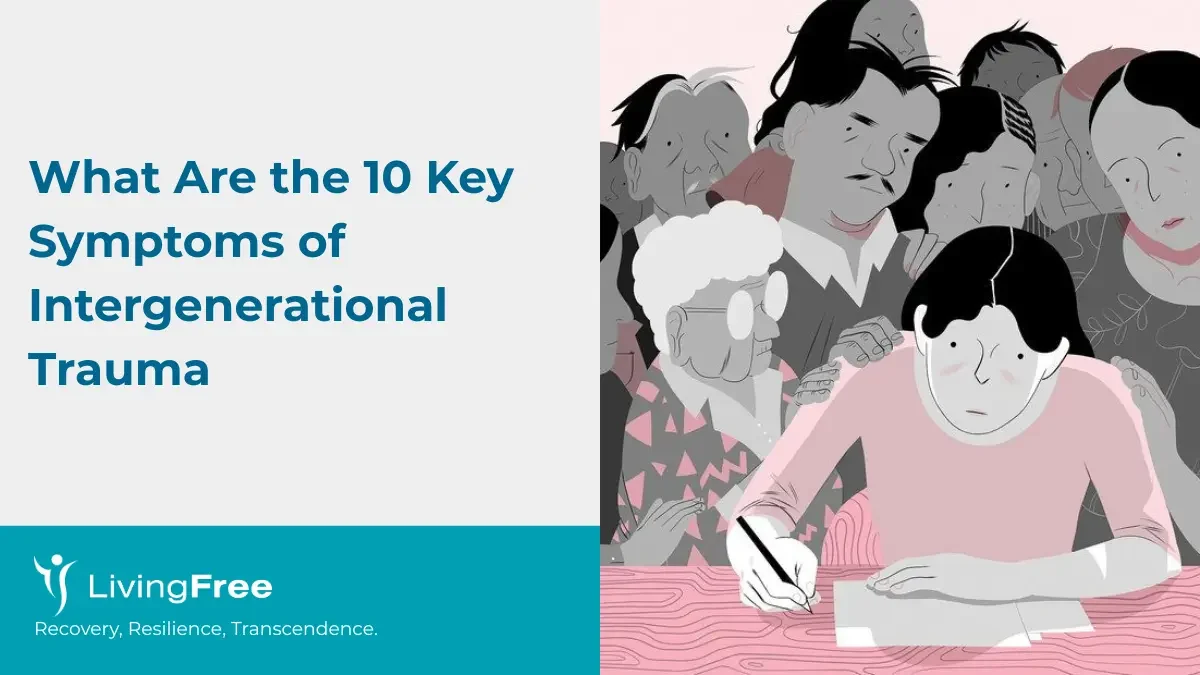
Have you ever felt a deep, unnamed sadness that doesn’t seem to connect to anything in your own life? Or found yourself caught in patterns of anxiety, shame, or broken relationships that feel far bigger than your personal history should explain? You might be carrying something that was never entirely yours to begin with.
Intergenerational trauma, also called generational trauma, transgenerational trauma, or ancestral trauma, is the transmission of psychological and physiological effects of traumatic experiences from one generation to the next. It works through parenting styles, attachment patterns, nervous system wiring, family communication, and even epigenetic changes to how genes are expressed. The result is that the emotional weight of what your parents, grandparents, or ancestors endured can quietly shape your inner world long before you ever consciously recognize it.
Understanding what generational trauma really is is the first step toward recognizing its symptoms in your own life. So, what are the 10 key symptoms of intergenerational trauma? Let’s look at each one closely.
Table of Contents
1. Anxiety, Depression, and Persistent Emotional Distress
Anxiety and depression are among the most consistently documented symptoms of intergenerational trauma. Children and grandchildren of trauma survivors show significantly higher rates of mood disorders, including generalized anxiety, major depression, and bipolar disorder, even when they have not personally experienced the events that shaped their family.
This is not ordinary worry or sadness. It is a nervous system that absorbed, through relationship and early environment, the emotional residue of a generation that could not fully heal. When a parent experiences the world as fundamentally dangerous, that worldview passes to the next generation without a single word being spoken. Research on Holocaust survivors found that while many avoided discussing their experiences directly with their children, their deeply held belief that catastrophe was always near shaped their children’s baseline emotional state in profound and measurable ways.
The anxiety can feel disproportionate to your circumstances. You may brace for disaster even when life is going well, or carry a low, constant hum of dread with no clear source. This is not a flaw in your character. It is a nervous system that learned, through inheritance, to stay ready.
2. Post-Traumatic Stress Disorder (PTSD) Symptoms Without a Personal Trauma History
One of the most disorienting aspects of intergenerational trauma is experiencing classic PTSD symptoms without having lived through an identifiable traumatic event yourself. People carrying this kind of inherited stress may notice:
- Emotional flooding triggered by seemingly minor situations
- An exaggerated startle response
- Persistent avoidance of certain topics, people, or environments
- Mood dysregulation that feels sudden and hard to explain
The key distinction between intergenerational PTSD symptoms and classic PTSD is that the person will generally not experience flashbacks or intrusive memories tied to a specific event, because the original trauma did not happen to them directly. Instead, the body appears to be reacting to something the mind cannot consciously remember, a pattern increasingly explained by epigenetic research showing that trauma can alter stress-response gene expression across generations.
A common thought that emerges with this symptom is, “Nothing bad happened to me, so why do I feel this way?” The answer, supported by both clinical observation and biological research, is that the body can carry what the mind has not consciously witnessed. If you recognize this in yourself, exploring how intergenerational trauma actually works can be an important part of making sense of your experience.
3. Denial and Minimization
Denial and minimization are among the most common, and least recognized, intergenerational trauma coping mechanisms. They typically originate in an older generation that survived by refusing to acknowledge the full weight of what happened to them. Unable or unwilling to process their own pain, they modeled a set of implicit rules: do not talk about it, do not feel it too deeply, and above all, do not let it define you.
This gets passed down. Descendants may find themselves reflexively dismissing their own struggles (“it wasn’t that bad,” “other people have it worse”), minimizing family history, or feeling a strange discomfort when others are openly vulnerable about pain. The silence surrounding trauma deepens shame, because when no one names what is present, children fill in the blanks with self-blame.
Denial at the family level can also manifest as a shared “conspiracy of silence,” where everyone implicitly knows something painful exists but no one is permitted to name it. This silence becomes its own transmission mechanism, passing distress forward precisely because it is never examined.
4. Low Self-Worth and Chronic Shame
A deep, bone-level sense of not being good enough is one of the most painful symptoms of intergenerational trauma. This is different from ordinary self-doubt. It is a shame that feels fundamental, as though there is something inherently flawed or undeserving about who you are, and it often has no single memory or event to explain it.
Shame is transmitted through family systems in several ways: through conditional affirmation and chronic criticism, through witnessing a parent who was themselves deeply ashamed, and through growing up in communities where trauma created cultures of silence and stigma. When pain is kept secret across generations, the suffering becomes internalized, and children absorb the message that whatever is wrong must be hidden, and therefore must be them.
This connection between intergenerational shame and the inner critic is also discussed in depth in the research on the link between childhood trauma and perfectionism in adulthood, where shame-driven achievement becomes its own inherited pattern.
5. Difficulty Trusting Others and Forming Secure Relationships
Trauma fundamentally alters a person’s relationship with trust, and when that mistrust is woven into the fabric of a family system, children absorb it as a given. Growing up with the implicit message that people are unreliable, that vulnerability leads to harm, or that love is conditional produces insecure attachment patterns that follow people into their adult relationships.
The transmission happens primarily through parenting. A parent with unresolved trauma may be emotionally unavailable, unpredictably warm and cold, or respond to a child’s distress with their own anxiety or shutdown. The child then internalizes an insecure attachment blueprint, not because they were intentionally harmed, but because the parent’s nervous system was still managing its own wounds. This is one reason why trauma shows up most intensely in close relationships: it is in intimacy that our earliest attachment patterns are most powerfully activated.
You may also notice a strong, sometimes inexplicable sense of loyalty to family of origin that makes it hard to form outside relationships or set limits. Families shaped by collective survival often developed closeness as a protection mechanism, and that pattern can persist long after the original threat has passed.
6. Substance Use and Unhealthy Coping Behaviors
Intergenerational trauma significantly increases the likelihood of turning to substances or other compulsive behaviors to manage overwhelming emotions. Alcohol, drugs, food, gambling, and other numbing strategies can become family patterns passed down not only through genetic vulnerability, but through modeled coping, emotional unavailability, and the absence of healthier emotional regulation tools.
When a child grows up watching a parent use alcohol to decompress, or when no one in the family had the language or capacity to sit with difficult feelings, the child has limited resources to draw from when their own stress becomes unmanageable. Research published in Frontiers in Psychiatry specifically identified substance use as both a consequence of inherited trauma and a mechanism through which it is further transmitted: parents whose own coping is chemically mediated struggle to provide the emotional attunement their children need, continuing the cycle.
Learning healthy coping mechanisms for trauma is one of the most direct ways to interrupt this particular thread of the cycle.
7. Hypervigilance and Exaggerated Threat Responses
Hypervigilance is a state of constant environmental scanning, always watching for signs of danger, betrayal, or rejection. People carrying intergenerational trauma may notice they read rooms the moment they enter them, analyze facial expressions for the slightest sign of disapproval, or find it genuinely difficult to relax even in safe environments.
Clinically, descendants of trauma survivors can carry inherited patterns of nervous system activation, including hypervigilance and emotional dysregulation, without knowing what they are actually responding to. The body is reacting to a threat that lives in the past, not the present. In relationships, this often looks like scanning for signs of withdrawal, interpreting neutral expressions as hostility, or needing constant reassurance that connection is still intact.
Hypervigilance is also closely connected to why relationships feel so hard after trauma. When your nervous system has been calibrated to expect danger, the very closeness that relationships require can trigger the same alarm systems that were designed for survival.
Dr. Reshie describes trauma as something that can emerge not only from catastrophic events, but also from repeated smaller experiences that gradually overwhelm the nervous system over time:
“You’ve got skin that’s very thick, very resilient, and you’ve got a knife that’s not particularly sharp, but if you keep hitting the knife against the skin, and you just keep doing it, at some point, you will penetrate.”
This helps explain why people carrying intergenerational trauma often live in a constant state of alertness even when they cannot point to one defining traumatic event.
8. Dysfunctional Family Communication Patterns
Families carrying unresolved trauma often develop rigid, unhealthy communication norms that pass quietly from one generation to the next. These can include:
- Persistent avoidance of difficult topics or family history
- Emotional invalidation, where feelings are dismissed or minimized
- Communication that is consistently conflictual, passive-aggressive, or chaotic
- Secrets that everyone knows but no one discusses
- An absence of repair after conflict, leaving ruptures to silently calcify over time
When children cannot ask honest questions about the past, they fill in the blanks themselves, often with explanations that center shame or self-blame. Research on intergenerational trauma consistently identifies broken or distorted family communication as both a symptom of inherited trauma and a primary pathway through which it travels forward. The silence is not neutral. It carries its own weight.
If you have wondered whether your family’s patterns reflect something deeper, reading about how to know if your family has generational trauma can offer real clarity.
9. Chronic Physical Symptoms and Illness
Intergenerational trauma is not only psychological. The body carries what the mind cannot fully process, and research consistently links adverse childhood experiences and parental trauma to a higher lifetime risk of chronic physical conditions, including heart disease, autoimmune disorders, chronic pain, digestive problems, asthma, and diabetes.
The biological mechanism is increasingly understood through epigenetics, the study of how behavior and environment influence gene expression without altering the underlying DNA itself. Trauma can alter the regulation of genes involved in stress response, immune function, and inflammation. These alterations can be inherited by the next generation, creating genuine biological vulnerability to illness whose origins lie in events that occurred decades before the person was born.
Importantly, epigenetic research also shows that these patterns are not fixed destiny. Safety, supportive relationships, and sustained healing practices can alter gene expression over time. What was inherited can, in many respects, be changed. You can read more about what this looks like in practice in a discussion of what unresolved trauma looks like in adults and how it shows up in the body.
10. Negative or Unhealthy Parenting Patterns
Perhaps the most consequential symptom of intergenerational trauma is the way it reproduces itself through parenting. Parents who have not healed their own inherited wounds tend to fall into one of two patterns, neither of which serves a child’s healthy development:
- Overprotection: excessive vigilance born from unresolved fear, shielding children from every risk in ways that inadvertently communicate that the world is dangerous
- Emotional unavailability: too consumed by managing their own internal state to be consistently present for a child’s emotional needs
In both cases, the parent is not failing from lack of love. They are failing in healed capacity, and the child absorbs the consequences. A parent with PTSD who freezes when a child is distressed may raise a child with insecure attachment through no intentional act of harm, simply through the lived reality of their own nervous system. This is how trauma passes most efficiently from generation to generation: not through dramatic acts but through the quiet daily patterns of relationship.
Understanding this is not about blame. It is about seeing the cycle clearly enough to interrupt it. If you are ready to explore that path, learning how to break generational trauma is where the most meaningful work begins.
What Connects All 10 Symptoms
Looking across these ten symptoms, a common thread runs through all of them: the nervous system of a person carrying intergenerational trauma has been calibrated for a world that may no longer exist. It is still responding to threats that belonged to another generation, still managing emotions that were never fully processed, still operating under beliefs about safety, trust, and worthiness that were formed in conditions of fear or survival.
Trauma travels through three overlapping pathways. Psychological and behavioral transmission occurs when traumatized parents model dysregulated patterns, communicate fear-based worldviews, or lack the emotional capacity to attune to their children. Epigenetic transmission refers to biological changes in gene expression, triggered by trauma, that can be passed to the next generation, altering vulnerability to stress, illness, and mental health challenges. Cultural and community transmission operates at the collective level, shaping shared beliefs, norms, and intergenerational narratives in communities shaped by historical injustice.
Understanding these pathways matters because it clarifies that intergenerational trauma is not a personal failing. It is a systemic pattern, and systemic patterns can be changed.
Can These Patterns Be Healed?
Yes. That is the most important thing to hold on to. Recognizing the cycle is already an act of interruption, because awareness creates choice where there was only automatic response. Therapeutic approaches with particular evidence for intergenerational trauma include trauma-focused cognitive behavioral therapy, EMDR (Eye Movement Desensitization and Reprocessing), Internal Family Systems therapy, somatic approaches that work directly with the body, and attachment-focused family therapy.
Beyond formal therapy, practices that build nervous system safety, consistent community, mindfulness, creative expression, and meaningful connection, all contribute to shifting inherited patterns at both the psychological and biological level. Healing does not require that you fully understand everything about your family’s history. What matters most is your willingness to meet what lives in you with curiosity rather than judgment, and to begin building, perhaps for the first time, the conditions of safety that your nervous system has always been searching for.
Final Thoughts
Intergenerational trauma is one of the most quietly widespread sources of human suffering, and also one of the most hopeful areas of modern psychology, because it carries within it the genuine possibility of change. When you begin to heal, you are not only doing it for yourself. You are doing it for every generation that comes after.
If these symptoms resonate with your experience, you deserve support that is compassionate, trauma-informed, and equipped to meet the full complexity of what you are carrying. At Living Free, we specialize in exactly that kind of healing. You do not have to navigate this alone. Contact us today and take the first step toward healing what was inherited so you can build the life you were always meant to live.