

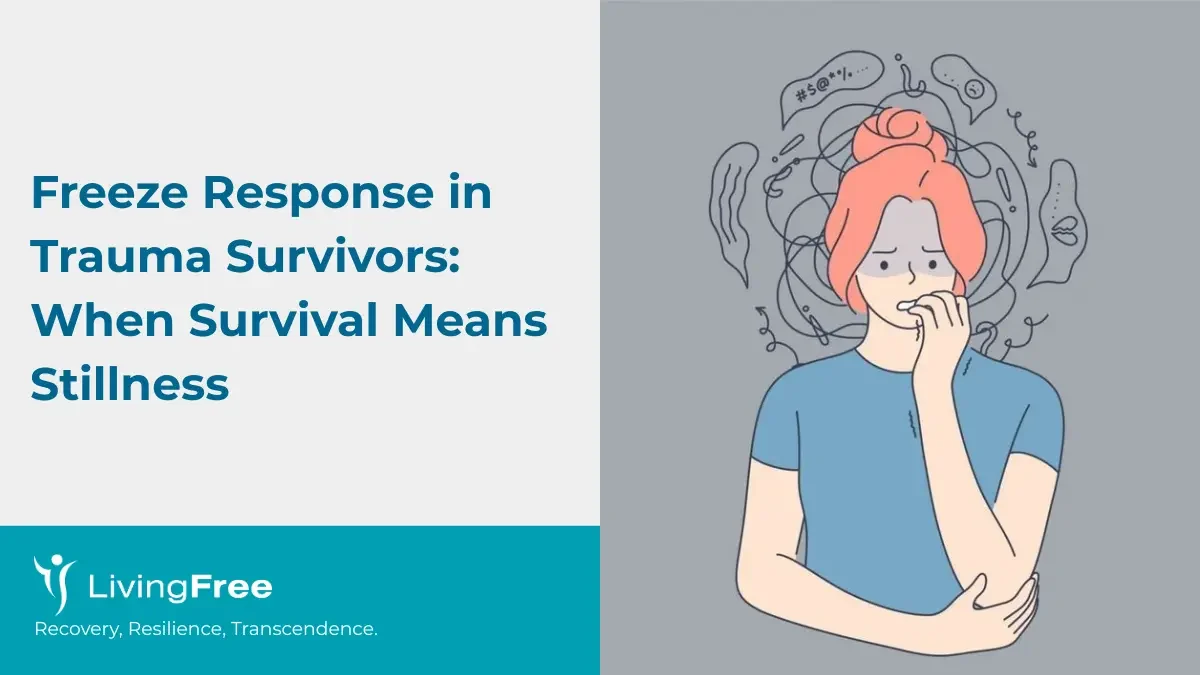
The freeze response in trauma survivors is one of the most misunderstood trauma reactions. Unlike fight or flight, freeze appears quiet, passive, and often invisible, yet it is one of the body’s most powerful survival strategies. Many trauma survivors live with chronic shutdown, emotional numbness, or paralysis without realizing these experiences are rooted in their nervous system’s attempt to stay safe.
This article explains what the freeze response is, why it develops, how it shows up in real life, and how trauma-informed healing supports recovery.
What Is the Freeze Response in Trauma Survivors?
The freeze response is an automatic nervous system reaction that occurs when a person perceives danger but feels unable to escape or defend themselves. In this state, the body enters immobility and shutdown rather than mobilization.
For trauma survivors, freeze often becomes a default response, activating even when no immediate threat exists. This happens because the nervous system learned, through past experiences that stillness and inhibition increased survival.
Why Trauma Survivors Experience the Freeze Response
Trauma reshapes the nervous system’s threat detection system. When fight or flight was not possible, such as in situations involving power imbalance, dependency, or repeated harm, the body adapted by freezing.
The freeze response in trauma survivors is commonly associated with:
- Childhood abuse or neglect.
- Sexual or physical violence.
- Emotional or psychological trauma.
- Medical or procedural trauma.
- Chronic stress or long-term threat.
In these situations, freezing was not a choice, it was a biological necessity.
Common Symptoms of the Freeze Response
Freeze responses affect multiple levels of experience. Survivors often report feeling “stuck” without understanding why.
Physical Symptoms
- Difficulty initiating movement.
- Heaviness or numbness in the body.
- Shallow breathing or breath holding.
- Sudden exhaustion.
Emotional Symptoms
- Emotional numbness.
- Reduced emotional range.
- Shame or frustration about not reacting.
Cognitive Symptoms
- Blank or foggy thinking.
- Trouble speaking or finding word
- Difficulty making decision
Behavioral Symptoms
- Procrastination or task paralysis.
- Avoidance of communication.
- Difficulty asserting boundaries.
- Compliance despite internal distress.
Examples of the Freeze Response in Trauma Survivors
The freeze response often appears in everyday situations, not just during obvious danger. Below are common, real-world examples of how freeze manifests in trauma survivors.
Example 1: Freezing During Conflict
A trauma survivor may want to speak up during an argument but suddenly feels unable to talk. Their mind goes blank, their body becomes tense or heavy, and words will not come, despite knowing what they want to say.
Example 2: Task Paralysis at Work
A survivor sits in front of a simple task but feels incapable of starting. The body feels immobile, the mind overwhelmed, and shame increases as time passes, reinforcing the freeze state.
Example 3: Shutdown in Relationships
When emotional closeness increases, a survivor may become distant, quiet, or numb. This is not disinterest but a nervous system response triggered by vulnerability.
Example 4: Inability to Say No
During uncomfortable situations, a survivor may comply even when they want to refuse. The freeze response limits access to assertive action, prioritizing safety through stillness.
Example 5: Physical Collapse After Stress
After prolonged stress or confrontation, a survivor may suddenly feel exhausted, need to lie down, or experience emotional flatness, signs of nervous system shutdown.
Freeze Response vs Dissociation
Freeze and dissociation often overlap but are not the same.
Freeze involves motor inhibition and physical shutdown, and dissociation involves altered awareness or disconnection.
| Aspect | Freeze Response | Dissociation |
|---|---|---|
| Primary Function | Survival through immobility and shutdown | Survival through psychological disconnection |
| Nervous System State | Dorsal vagal activation (parasympathetic shutdown) | Altered consciousness with varying nervous system involvement |
| Body Experience | Heavy, tense, numb, unable to move or act | Detached, unreal, disconnected from body or surroundings |
| Movement | Inhibited or frozen | May move normally or automatically |
| Awareness | Present but immobilized | Reduced, altered, or fragmented awareness |
| Emotional Access | Emotions muted or flattened | Emotions disconnected or compartmentalized |
| Cognitive State | Blank mind, difficulty speaking or deciding | Spacing out, memory gaps, depersonalization or derealization |
| Speech | Difficulty initiating speech | Speech may continue, but feel automatic or distant |
| Sense of Control | Feels stuck or trapped in the body | Feels disconnected from self or reality |
| Common Triggers | Confrontation, overwhelm, authority figures | Intense emotional or sensory overload |
| Can Occur Together? | Yes | Yes |
A trauma survivor may experience one or both, depending on context and nervous system history.
The Nervous System Behind the Freeze Response
The freeze response in trauma survivors is regulated by the autonomic nervous system, particularly the dorsal vagal pathway. When activated, this system conserves energy by reducing movement, speech, and emotional expression.
This state is not a conscious decision, it is a bottom-up biological process designed to maximize survival under threat.
How Freeze Shows Up in Daily Life
Freeze can become part of everyday functioning, appearing during:
- Conversations with authority figures.
- Decision-making situations.
- Performance demands.
- Emotional discussions.
- Moments requiring assertiveness.
Over time, repeated freezing can lead survivors to believe something is “wrong” with them, rather than recognizing a trauma-based pattern.
Why the Freeze Response Is Often Misunderstood
Because freeze lacks visible struggle, it is often mislabeled as:
- Laziness.
- Avoidance.
- Lack of motivation.
- Emotional disengagement.
In reality, freeze reflects a temporary loss of nervous system flexibility, not a character flaw.
Healing the Freeze Response in Trauma Survivors
Healing the freeze response does not come from forcing action or “pushing through.” Because freeze is stored in the body, healing requires somatic and nervous-system-informed approaches.
Supportive strategies often include:
- Body-based trauma therapies
- Gradual, safe movement
- Breath awareness without forcing relaxation
- Co-regulation through safe relationships
- Building awareness of early shutdown signals
The aim is to restore a sense of safety and choice, not to eliminate freeze entirely.
Reframing Freeze as a Survival Strategy
The freeze response in trauma survivors is not a malfunction, it is an adaptation shaped by past experiences. When survivors understand freeze as a protective response rather than a failure, self-compassion increases and healing becomes possible.
Final Thougths
The freeze response in trauma survivors is not a flaw or failure, it is a nervous system survival strategy shaped by past experiences. Understanding freeze with compassion allows healing to focus on safety, awareness, and gradual reconnection rather than self-blame or force.
If you’d like to learn more about trauma-informed, nervous-system, based healing, explore additional resources at livingfree. For personal support or professional guidance, feel free to contact us here, you don’t have to go through this alone.
Related Post: